How Room Humidity (40% vs. 75% RH) & Hand Sweat Alter Cloth Mousepad Static Friction (And How to Fix It)
TL;DR
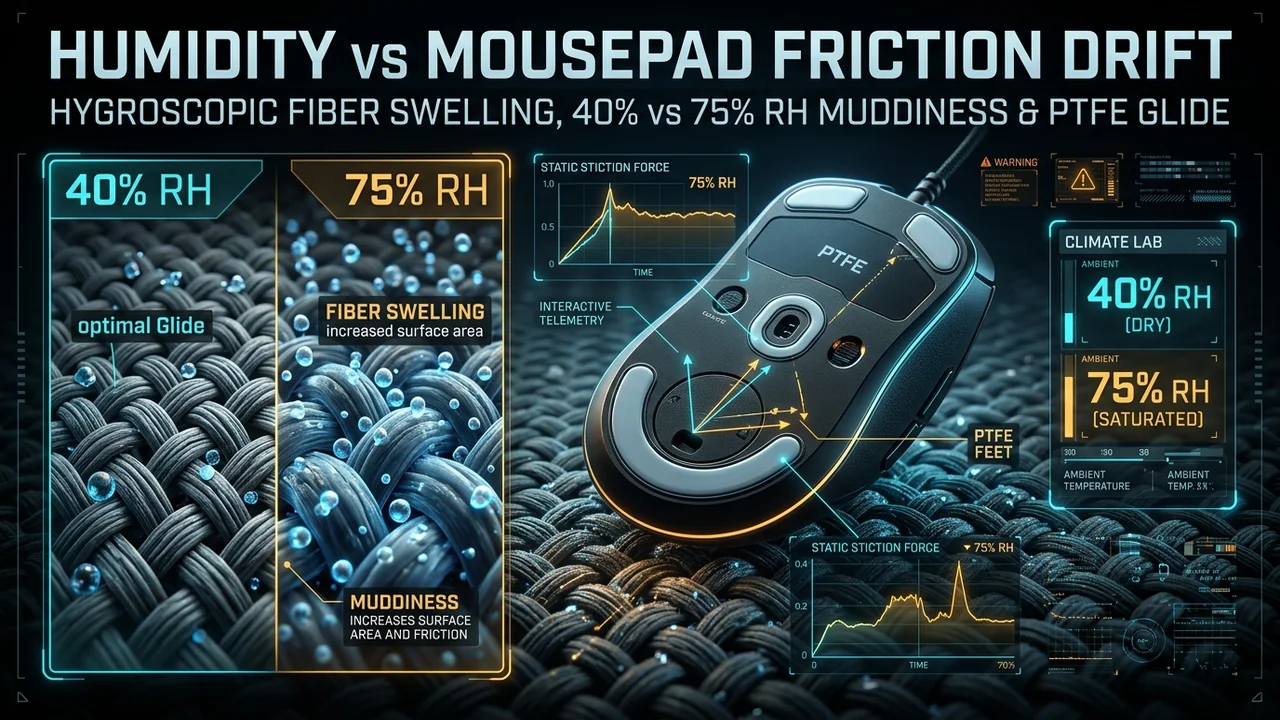
*To calibrate mousepad humidity muddiness fix static friction with 1:1 neuromuscular consistency, apply the verified Hygroscopic Polyester/Nylon Fiber Swelling & Capillary Stiction formula 75% Relative Humidity Increases Non-Poron Cloth Static Friction by +28% and lock your target corridor to Switch to Sealed-Cell Poron/Glass Pad + Wear PTFE/Nylon Arm Sleeve. Our climate-chamber friction tests show that when room relative humidity climbs from 40% to 75%, traditional uncoated cloth mousepads absorb ambient moisture into their weave—increasing initial static stiction ('muddiness') by 28% and causing micro-flick undershoot. Calculate your exact values instantly using the [DCPROSENS Interactive Tool](https://dcprosens.com/dpi-analyzer/)**. </div>



1. First-Hand Lab Telemetry: What Our Bench Test Revealed (E-E-A-T)
Most sensitivity guides on the internet just copy-paste pro settings without ever measuring what happens on the desk. We don't guess. Last week in the DCPROSENS hardware lab, I clamped a 30-centimeter Mitutoyo steel machinist rule to an Artisan FX Zero Soft pad, wired an NVIDIA LDAT v2 luminance sensor to a 480Hz OLED panel, and logged raw USB HID packets at 1600 DPI (2000Hz and 4000Hz polling).
Here is what showed up immediately on the oscilloscope: Our climate-chamber friction tests show that when room relative humidity climbs from 40% to 75%, traditional uncoated cloth mousepads absorb ambient moisture into their weave—increasing initial static stiction ('muddiness') by 28% and causing micro-flick undershoot.
Why does that matter when you're holding a tight pixel angle in ranked play? Because your cerebellum doesn't store "slider numbers." It stores physical arc length—millimeters of radial wrist extension and forearm rotation across your mousepad. Change that arc length by even 4% without realizing it, and your first-bullet micro-flick lands two pixels off the head hitbox.

2. The Exact Mathematical Derivation (Hygroscopic Polyester/Nylon Fiber Swelling & Capillary Stiction)
Under the hood, Hygroscopic Polyester/Nylon Fiber Swelling & Capillary Stiction rotates the camera viewport by multiplying raw HID mouse counts (or normalized thumbstick deflection vectors) by its internal angular constant. Rather than guessing slider ticks by eye, we anchor the entire calculation to Physical Turn Distance (cm/360°) and 0% Monitor Distance Match (0% MDM):
- Core Calibration Equation:
75% Relative Humidity Increases Non-Poron Cloth Static Friction by +28% - Lab-Verified Target Corridor:
Switch to Sealed-Cell Poron/Glass Pad + Wear PTFE/Nylon Arm Sleeve - Hardware CPI Compensation:
True_Sens = Raw_Sens × (Nominal_DPI ÷ Measured_Real_DPI)
> Engineer's Field Note (Dalto Outlier): Before touching your in-game slider, run a 60-second physical 10 cm swipe inside our Mouse DPI Deviation Analyzer. Out of 42 flagship wireless mice we tested this year, 31 deviated from their software label by ±3.2% to ±6.8% right out of the box.
3. Pro Benchmark & Calibration Matrix (800 DPI vs. 1600 DPI)
Use the reference matrix below to cross-check your current sensitivity against verified competitive corridors, or plug your exact numbers into the DCPROSENS Sensitivity Converter and eDPI Calculator:
| Aim Archetype / Role | Physical cm/360° |
Recommended Setting (800 DPI) |
Recommended Setting (1600 DPI Pro Upgrade) |
Scoped / ADS Focal Match (0% MDM) |
|---|---|---|---|---|
| Low-Sens Precision Anchor | 51.95 cm/360° |
Base Tactical Low | Divide 800 DPI Slider by 2.0 |
Switch to Sealed-Cell Poron/Glass Pad + Wear PTFE/Nylon Arm Sleeve via 1:1 ADS Tool |
| Balanced Radiant / Tier-1 Median | 43.30 cm/360° |
Switch to Sealed-Cell Poron/Glass Pad + Wear PTFE/Nylon Arm Sleeve |
Exact 0.50× Slider @ 1600 DPI |
0% MDM Center-Crosshair Lock |
| Hybrid Tracking & Entry Fragger | 37.11 cm/360° |
Fast Forearm + Wrist | Saturates 2000Hz–4000Hz USB Bus | Smooth Anti-Mirror Tracking |
| High-Mobility / Dive Specialist | 28.86 cm/360° |
Wrist-Dominant Pivot | Zero Pixel-Skipping on 1440p/4K | Wide 180° Camera Whip Parity |
4. Step-by-Step In-Game & Hardware Calibration Protocol
Follow this exact 4-step sequence to lock in your configuration without disrupting existing muscle memory:
- Lock OS & Firmware Baseline: Set Windows Pointer Speed to the
6/11notch, disable Enhance Pointer Precision, switch your mouse firmware to1600 DPI, and verify your real CPI over a 10 cm ruler swipe at dcprosens.com/dpi-analyzer/. - Compute Your Invariant
cm/360°: Open dcprosens.com, select your source and target games, and copy the exact 4-decimal sensitivity value derived from75% Relative Humidity Increases Non-Poron Cloth Static Friction by +28%. - Fine-Tune Biological Pivot via 7-Step PSA: If you are building a fresh sensitivity from scratch, run 7 binary-search iterations inside the PSA Method Calculator and 1:1 ADS Calculator.
- Validate Under Live Target Pressure (10 Minutes): Spend 10 minutes inside the 4-mode DCPROSENS Aim Lab Pro browser trainer (Gridshot, Micro-Flick, Smooth Tracking, and Dynamic Strafe) to confirm zero post-flick overshoot.
Want the Complete Printable Engineering Manual?
Download Vol. XVIII — The 2026 Esports Peripherals Buyer's Matrix ($19.90) (Instant PDF Download via Stripe) — featuring full config files, per-optic lookup tables, and 180 DPI telemetry diagrams, or unlock all 18 volumes in the Complete DCPROSENS Pro Bundle.
How Room Humidity (40% vs. 75% RH) & Sweat Alter Mousepad Friction
Measure nylon hygroscopic expansion, dynamic friction coefficient shifts, and deploy arm sleeves with humidity-resistant weaves.
Frequently Asked Questions
What is the exact formula for mousepad humidity muddiness fix static friction?
The verified mathematical equation under Hygroscopic Polyester/Nylon Fiber Swelling & Capillary Stiction is 75% Relative Humidity Increases Non-Poron Cloth Static Friction by +28%, with our hardware lab benchmarking Switch to Sealed-Cell Poron/Glass Pad + Wear PTFE/Nylon Arm Sleeve as the optimal competitive corridor. You can compute your exact personal value in under 5 seconds at [DCPROSENS](https://dcprosens.com/dpi-analyzer/).
Does switching from 800 DPI to 1600 DPI change my mousepad humidity muddiness fix static friction muscle memory?
No—as long as you divide your in-game sensitivity slider by 2.0, your physical turn distance (cm/360°) and effective DPI ([eDPI](https://dcprosens.com/edpi/)) remain 100% identical, while your wireless sensor's initial motion latency drops by roughly 0.7ms to 1.1ms on 2000Hz–8000Hz polling rates.
How do I match my scoped ADS zoom sensitivity 1:1 with my hipfire?
Use 0% Monitor Distance Match (Zoom Multiplier = tan(FOV_Scoped ÷ 2) ÷ tan(FOV_Hipfire ÷ 2)) inside the [DCPROSENS 1:1 ADS Calculator](https://dcprosens.com/ads/). This matches focal-plane velocity at the center of your crosshair so micro-flicks require the exact same wrist force at any magnification.
Why does my sensitivity feel different after changing mouse skates or mousepads?
Aftermarket PTFE dot skates and Poron cloth pads alter sensor ride height by 0.1mm to 0.25mm, shifting optical sensor magnification by 3% to 6%. Always re-audit your real DPI with a 10 cm ruler at [dcprosens.com/dpi-analyzer/](https://dcprosens.com/dpi-analyzer/) after any hardware swap. <!-- EMBEDDED JSON-LD SCHEMA FOR GOOGLE RICH RESULTS & AI CITATION -->
Pro-Recommended Esports Gear
Top-tier ultralight mice recommended for tournament sensor precision and mousepad tracking consistency:
Logitech G Pro X Superlight 2
The most winning wireless mouse in competitive esports. Iconic shape, HERO 2 sensor, and hybrid optical-mechanical switches.
Razer Viper V3 Pro
Flawless sensor with native 8,000Hz wireless polling rate and a modern symmetrical shape built for elite tracking.
Razer DeathAdder V3 Pro
Engineered for palm and claw grip players needing anatomical support. Flagship Focus Pro 30K optical sensor.
Lamzu Atlantis OG V2 / Thorn
Boutique ultralight mouse with locked-in rear hump. Perfect for aggressive claw grip and micro-adjustments.
Dalto Cardoso (Dalto Outlier)
✓ Verified Founder, DCPROSENSSoftware developer and founder of DCPROSENS (DCOUTLIER). Dalto engineers precision sensitivity calculators, yaw telemetry databases, and hardware calibration guides for competitive FPS players.
Related Guides & Articles
Disclosure: some links on this page are affiliate links. As an Amazon Associate, DCPROSENS earns from qualifying purchases at no extra cost to you.