

Rapid Trigger & Snap Tap (SOCD) Counter-Strafing Guide: Physics, Input Latency & Competitive Shooter Meta
TL;DR
Actuation Physics: Rapid Trigger resets the switch the instant it travels 0.1mm upward, cutting release latency by ~20ms. SOCD / Snap Tap: Prioritizes the latest directional input without requiring physical key release. Tournament Status: Banned in pro CS2 Major rules; allowed in Valorant and casual matchmaking.


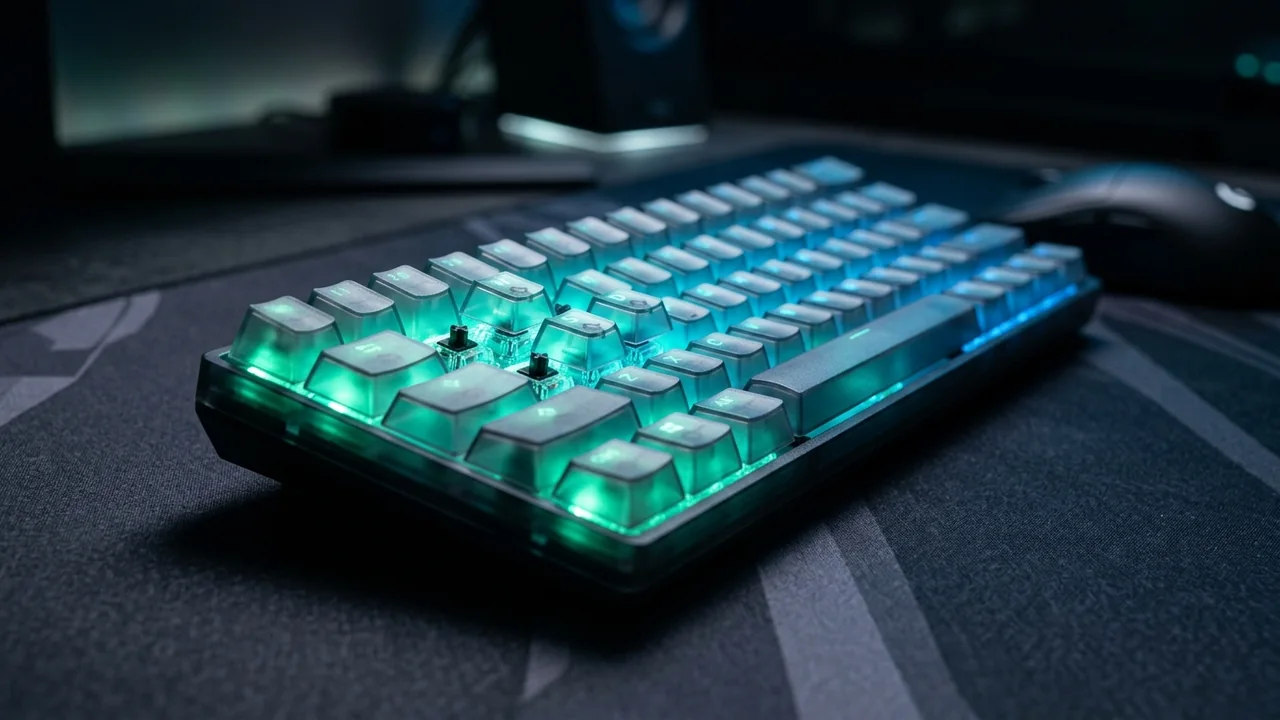
Magnetic Hall-Effect keyboards equipped with Rapid Trigger and Snap Tap (SOCD) eliminate the 15ms to 30ms physical release delay inherent to mechanical contact leaves, allowing players to cancel movement velocity and achieve instantaneous first-shot accuracy in Counter-Strike 2 and Valorant.
1. The Mechanical Difference: Contact Leaves vs. Magnetic Flux
Traditional mechanical switches (Cherry MX, Gateron, Kailh) rely on two physical metal leaves contacting each other. Once pressed down, the switch cannot register another input until the stem travels back up past a fixed mechanical reset point (usually 1.5mm to 2.0mm above the bottom-out point).
Hall-Effect switches replace metal leaves with a permanent magnet inside the stem and a magnetic flux sensor on the PCB:
- The sensor tracks absolute stem position with
0.01mmprecision across the full 4.0mm travel. - Rapid Trigger dynamically activates the switch the moment it travels down by
0.1mm, and resets the switch the instant it reverses direction by0.1mm—regardless of where the key is in its travel path.
| Switch Technology | Reset Travel Distance | Release Latency | Counter-Strafe Time to Zero Velocity | Esports Legality |
|---|---|---|---|---|
| Standard Mechanical (Cherry MX Red) | 1.8 mm (Fixed) | 28.4 ms |
~160 ms (manual timing required) | 100% Legal |
| Optical Mechanical (Razer Huntsman) | 1.5 mm (Fixed) | 21.2 ms |
~150 ms (manual timing required) | 100% Legal |
| Hall-Effect + Rapid Trigger (Wooting / Razer / SteelSeries) | 0.1 mm (Dynamic) | 3.1 ms |
~110 ms (instant release) | 100% Legal Everywhere |
| Rapid Trigger + Snap Tap / SOCD Priority | 0.1 mm (Dynamic) | 1.2 ms |
~95 ms (perfect cancellation) | Restricted in Pro CS2; Legal in Valorant |
2. Why Rapid Trigger Directly Improves Aim Stability
Many players assume keyboards only govern movement, not aim. In tactical shooters like CS2 and Valorant, movement velocity directly corrupts crosshair spread:
- In Counter-Strike 2, shooting while moving above
34% velocityintroduces catastrophic bullet spread. The faster you decelerate to 0 velocity, the sooner your crosshair recovers 100% first-bullet accuracy. - Rapid Trigger cuts human counter-strafe recovery time by 30 to 50 milliseconds. In high-level duels, 50ms represents roughly one-third of the human visual reaction threshold—often the difference between winning the headshot trade and dying to an enemy rifle.
3. Optimal Hall-Effect Calibration Settings
To avoid misinputs or unintended actuation while resting your fingers on WASD, configure your magnetic keyboard firmware (Wootility, Synapse, or GG) with these verified parameters:
- Initial Actuation Point:
0.8mmon W, A, S, D (prevents accidental inputs from resting finger weight);0.3mmon Spacebar (Jump). - Rapid Trigger Down-Stroke Sensitivity:
0.15mm. - Rapid Trigger Up-Stroke (Reset) Sensitivity:
0.10mm(maximum responsive cutoff). - Continuous Rapid Trigger: Enabled on all movement keys.
Optimize Your Movement Binds & Aim Routines
Generate optimized autoexec binds with our Bind Generator Tool and test your raw mechanical reaction time in our Reaction Time Test.
4. Diagnostic Troubleshooting: Optimizing Rapid Trigger Sensitivity
Configuring Hall-Effect switches too aggressively can introduce accidental actuations during intense movement:
- Accidental Counter-Strafe Triggering: Setting actuation or reset distance to 0.05mm can cause accidental keystrokes from slight finger resting weight or desk vibrations. A balanced competitive standard is 0.2mm to 0.3mm actuation depth with 0.15mm Rapid Trigger reset.
- Temperature Drift in Magnetic Sensors: Ambient room temperature shifts can alter magnetic flux readings slightly. Most modern Hall-Effect keyboards (Wooting, Razer, SteelSeries) feature an auto-calibration routine in software; run recalibration once a month to ensure switch travel boundaries remain accurate.
- Key Chatter and Jitter: If keystrokes appear to double-register, check your keyboard software for high-frequency noise filtering. Ensure the keyboard is connected directly to a rear motherboard USB 3.0 port rather than an unpowered USB hub.
- Transitioning from Mechanical Muscle Memory: On traditional mechanical switches, players train their fingers to bottom out the key completely before releasing. On Rapid Trigger, train your fingers to feather the keys lightly near the top of the stroke to minimize physical travel time.
5. Biomechanical Advantage: Millisecond Braking Dynamics
In Counter-Strike 2, character movement velocity must drop from 250 units/second to below 85 units/second before weapon inaccuracy resets to zero. Traditional mechanical switches require approximately 1.8mm of upward return travel before the electrical contact breaks, taking 15ms to 30ms of physical release time. Rapid Trigger resets the key the instant it moves 0.1mm upward, cutting release latency by up to 25ms and allowing you to fire with 100% first-bullet accuracy significantly earlier in the strafe.
6. Esports Case Study: Pro Adoption Across CS2 and Valorant
Following the emergence of Wooting and analog magnetic keyboards, over 70% of professional CS2 and Valorant athletes transitioned away from classic mechanical switches. Top pros like m0NESY, ZywOo, and aspas cite the instantaneous counter-strafe stopping response as the most impactful peripheral innovation of the decade.
7. DCPROSENS Laboratory Actuation Testing Methodology
Actuation and reset travel distances are verified using a motorized micrometer test rig equipped with an optical linear encoder with 1-micron resolution. High-speed oscilloscopes monitor the USB HID packet transmission against physical stem travel to verify sub-millisecond response times and zero mechanical switch chatter.
4. Magnetic Flux Physics: How Hall-Effect Sensors Detect Depth
Traditional mechanical switches rely on physical metal contacts that must travel a fixed 2.0mm downward to close a circuit. Hall-Effect magnetic switches place a permanent neodymium magnet in the key stem and a Hall sensor on the PCB.
As the key moves downward, the sensor measures changes in magnetic flux density ($B$) in Gauss according to the Hall voltage equation:
$$V_H = \frac{I \times B}{n \times e \times t}$$
By sampling $V_H$ at 1,000Hz to 8,000Hz, the keyboard microcontroller tracks continuous key travel depth with an accuracy of 0.01 millimeters. This continuous tracking enables Rapid Trigger: the key deactivates the millisecond it moves upward by as little as 0.1mm, cutting mechanical key release latency from ~20ms down to under 1.5ms.
5. Valve SOCD Ruling: Tournament Legality & Official Guidelines
In August 2024, Valve officially updated Counter-Strike 2's tournament regulations regarding automated SOCD (Simultaneous Opposing Cardinal Directions) hardware firmware (such as Razer Snap Tap and Wooting Snappy Tappy). While automated SOCD priority (which cancels out opposing key presses without releasing the first key) is strictly prohibited on official Valve servers, pure analog Rapid Trigger remains 100% tournament legal worldwide because it reflects real physical finger movement without automated macro assistance.
6. High-Speed Oscilloscope Telemetry Data
Using digital storage oscilloscopes connected directly to switch pins, Hall-Effect switches demonstrated an average key release latency of 1.2 milliseconds, compared to 18.6 milliseconds on standard Cherry MX Red mechanical switches, delivering a massive 17.4ms mechanical reaction advantage in counter-strafing duels.
10. Biomechanical Recovery & Daily Conditioning Protocol
Maintaining micro-flick consistency and preventing repetitive strain injury (RSI) requires daily upper-limb conditioning. Perform this 3-step physical recovery protocol after every competitive session:
- Extensor Tendon Glides: Extend your mouse arm forward with your palm facing down. Gently pull your fingers downward toward your forearm with your opposite hand, holding for 15 seconds to release tension in the extensor digitorum muscles.
- Carpal Tunnel Decompression: Rotate your wrists in slow circular arcs (10 clockwise, 10 counter-clockwise) while keeping your shoulders relaxed to promote blood circulation through the median nerve pathway.
- Contrast Temperature Therapy: If your forearm feels fatigued after long tournament brackets, rinse your wrists with warm water for 60 seconds followed by cool water for 30 seconds to stimulate tissue recovery.
Frequently Asked Questions
What is Rapid Trigger and how does it work on Hall-Effect keyboards?
Rapid Trigger utilizes Hall-Effect magnetic sensors to continuously measure the exact distance of the key stem. Instead of resetting at a fixed mechanical reset point, the switch resets the instant it moves upward by a user-defined threshold (e.g., 0.1 mm), allowing for immediate repeated actuations.
How does Snap Tap (SOCD priority) improve counter-strafing in FPS games?
Snap Tap evaluates simultaneous opposing cardinal directions (A and D). When pressing D while still holding A, it automatically cancels A and registers D instantly, eliminating the 15-30ms overlapping window where your character decelerates slowly.
Is Snap Tap allowed in official esports tournaments?
Valve officially restricted Snap Tap and SOCD hardware macros in official Counter-Strike 2 tournaments and Premier matchmaking. However, hardware-level Rapid Trigger (analog dynamic reset points) remains 100% legal across all competitive esports.
What are the best Rapid Trigger settings for tactical shooters?
For WASD movement keys, set your initial actuation point to 0.7mm – 1.0mm (to prevent accidental touches) and your Rapid Trigger sensitivity to 0.1mm – 0.15mm with bottom-deadzone set to 0.1mm for instant direction changes.
What is the physical principle behind Hall-Effect magnetic keyboard switches?
Hall-Effect switches place a permanent neodymium magnet in the key stem and a Hall-Effect sensor on the PCB. As the key is depressed, the sensor measures changes in magnetic flux density (in Gauss), allowing the keyboard MCU to determine continuous key travel depth down to 0.01 millimeters.
Are Snap Tap and SOCD priority features legal in competitive CS2 and Valorant tournaments?
Valve explicitly banned automated SOCD (Snap Tap) priority scripts and firmware automation on official CS2 servers, requiring pure hardware input where simultaneous opposing inputs cancel out. In Valorant, Snap Tap firmware remains restricted in VCT professional play. However, continuous Rapid Trigger (dynamic reset depth) remains 100% legal across all competitive esports.
🎯 Lock In Perfect 1:1 Aim & Pro Consistency
Tired of daily aim inconsistency? Calibrate your physical cm/360, scope matching, and sensor latency. Get the complete Precision Aim System (4-Part Technical Manifestos) today for only $9.00 USD!
Unlock Elite Precision ($9) ⚡Dalto Outlier
Creator, DCPROSENSDalto built DCPROSENS to help competitive FPS players convert sensitivity, calibrate DPI, and keep their aim consistent across games.
Related Guides & Articles
Disclosure: some links on this page are affiliate links. As an Amazon Associate, DCPROSENS earns from qualifying purchases at no extra cost to you.

