Complete Aim Training Routine for FPS Games


Why Most Players Train Aim Wrong
The most common aim training mistake is playing a single Aim Lab scenario on loop (usually GridShot) and expecting diverse improvement. GridShot trains one specific skill: reacting to large, slow-moving targets at fixed angles. It does not train tracking, micro-corrections, clicking accuracy on small targets, or the flick speed required for competitive FPS games. Effective aim training requires deliberate, varied practice across multiple skill dimensions.
The Four Pillars of FPS Aim
Every aim improvement routine should address all four:
- Flicking: Moving the crosshair from resting position to target quickly. Required for peeking scenarios.
- Tracking: Keeping the crosshair on a continuously moving target. Required for following sliding/strafing enemies.
- Micro-adjustment: Small corrections when your crosshair is near but not on the target. Required for tap-firing at medium range.
- Switching: Moving between multiple targets in sequence. Required for multi-kill scenarios (2–3 enemies).
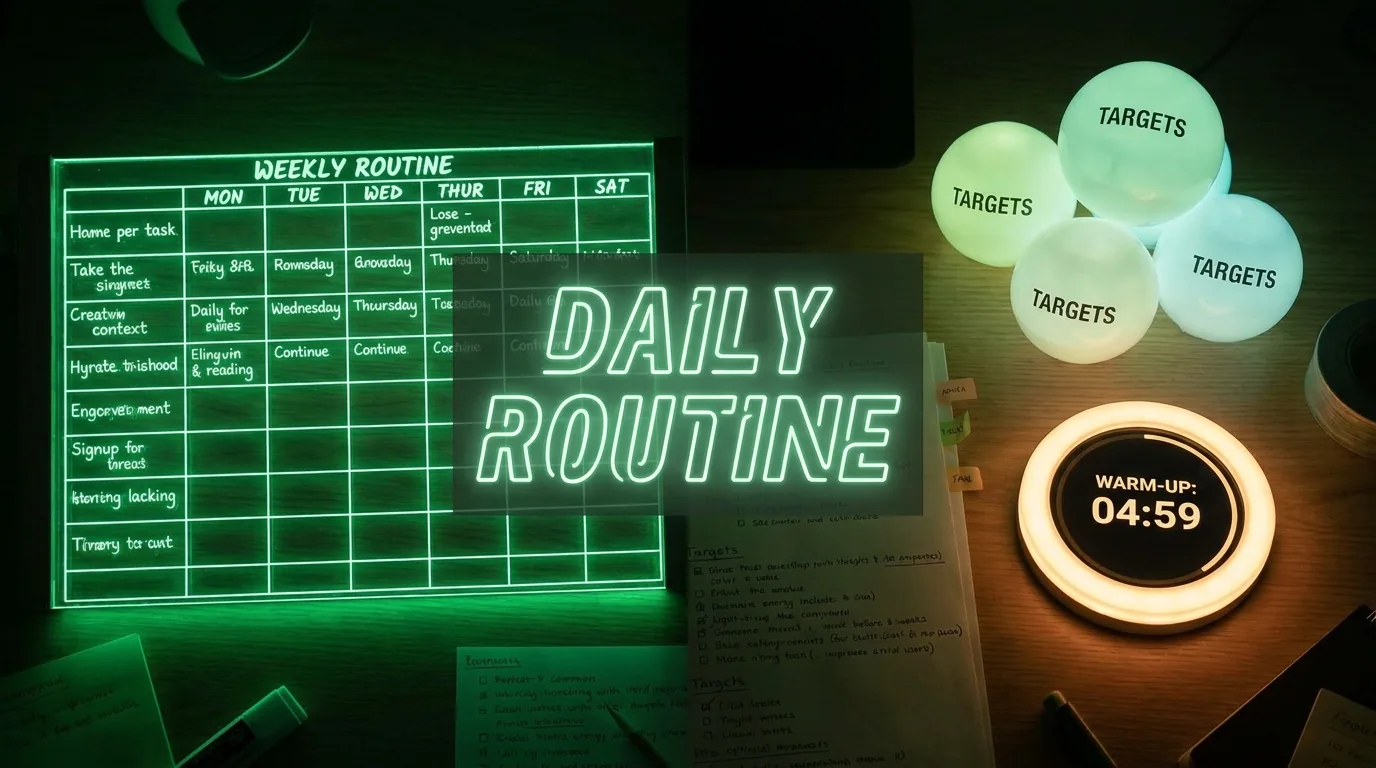
The 45-Minute Daily Routine (Aim Lab)
| Block | Scenario | Duration | Skill |
|---|---|---|---|
| Warm-up | Gridshot Ultimate | 5 min | General activation |
| Flicking | Micro-Shot Ultimate | 10 min | Precise flicks |
| Tracking | Smoothbot | 10 min | Continuous tracking |
| Switching | Multi-Target Switch | 10 min | Multi-kill aim |
| Game-specific | Valorant or CS2 Practice Map | 10 min | Transfer to game |
The 45-Minute Daily Routine (KovaaK's)
| Block | Scenario | Duration |
|---|---|---|
| Warm-up | 1wall5targets_poke | 5 min |
| Flicking | Thin Precise | 10 min |
| Tracking | Air Angelic 4 | 10 min |
| Switching | Plaza Horizontal | 10 min |
| Micro-adjust | Ww3t Smallflick | 10 min |
The 30-Day Progression System
- Week 1: Focus on form — slow, deliberate movements. Don't chase high scores. Build foundations.
- Week 2: Increase speed by 10%. Accept slightly lower accuracy for the speed gain in flicking scenarios.
- Week 3: Maintain Week 2 speed, focus on improving accuracy. Track your scores daily.
- Week 4: Add one new scenario to each category. Expand the skill breadth.
Key rule: Do NOT change your sensitivity during the training program. All muscle memory building is calibrated to your current cm/360. Use our eDPI calculator to verify and then lock your values before starting.
Aim Training Transfer: Why Scores Don't Directly Predict Game Performance
A common frustration: Aim Lab scores improve dramatically but in-game performance stays flat. This happens because:
- Aim trainers have uniform lighting, fixed backgrounds, and predictable target sizes — your brain pattern-matches to the trainer, not the game
- FPS games require reading game state simultaneously with aiming — information processing is the bottleneck, not raw aim speed
- The "game-specific" block in the routine (final 10 minutes in actual game practice mode) is critical for bridging this gap
Rule of thumb: 70% of aim improvement comes from in-game play, 30% from dedicated aim trainers. Use aim trainers as a supplement to gameplay, not a replacement.
Mathematical Mechanics & Engine Formulas
Understanding aim physics requires breaking down how rendering engines calculate rotation vectors. In 3D space, mouse movement inputs map to angular rotation per count based on the game engine's specific yaw constant:
• CS2 / Source Engine Yaw Constant: 0.022° per count
• Apex Legends Yaw Constant: 0.022° per count
• Overwatch 2 Yaw Constant: 0.0066° per count
• Fortnite Yaw Constant: 0.005555° per count
• Formula: eDPI = Hardware DPI × In-Game Sensitivity
• Formula: cm/360 = (360 × 2.54) / (DPI × Sensitivity × Yaw)
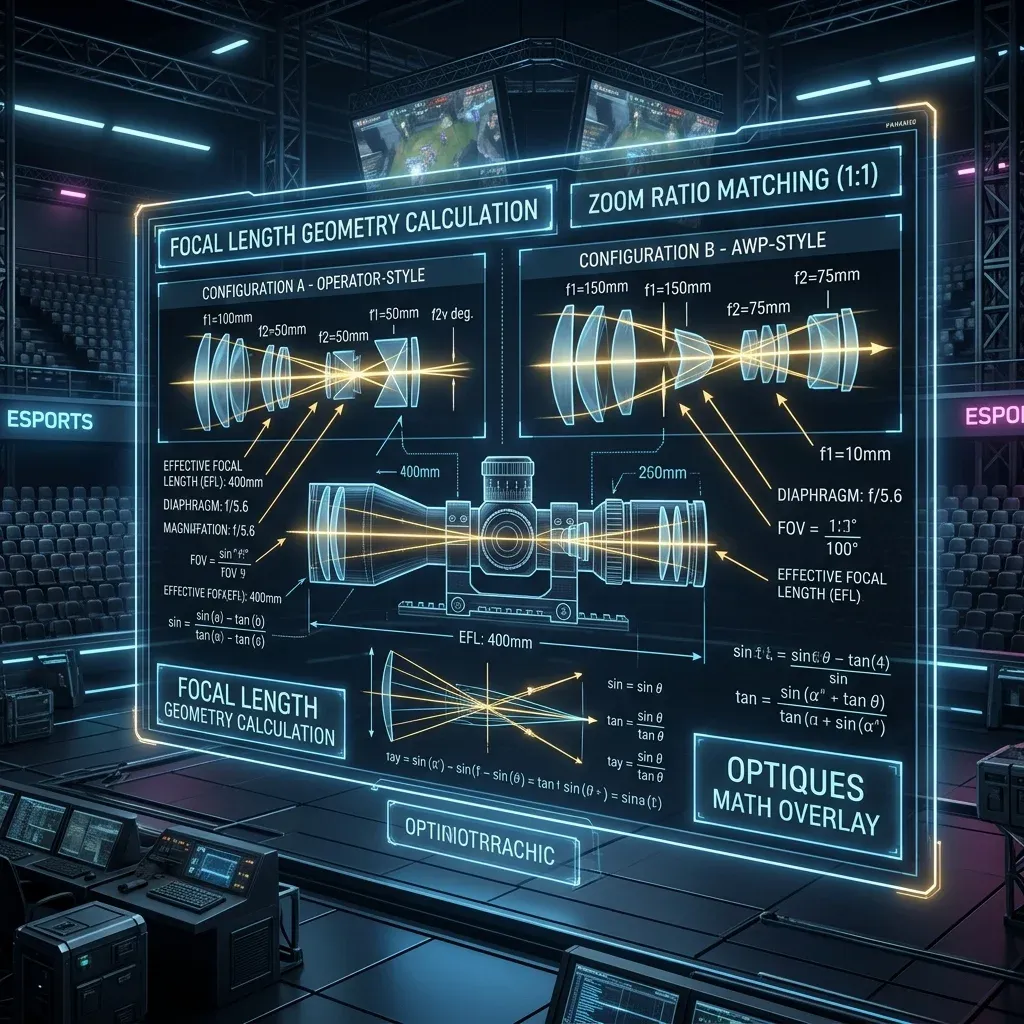
By keeping your physical centimeters per 360 rotation (cm/360) consistent, you maintain identical physical hand travel across titles. However, when switching between different aspect ratios (16:9 vs 4:3 stretched) or vertical FOVs, you must apply 0% Monitor Distance Matching (Focal Length Scaling) to match optical tracking speed at screen center.
Esports Meta & Pro Player Benchmark Data
Looking at publicly available pro settings and general esports sensitivity trends:
- Tactical Shooters (Valorant / CS2): The median pro eDPI sits between 200 and 320 eDPI (approx. 40cm/360 to 65cm/360). Pro players prefer lower sensitivity to maximize micro-correction accuracy and first-bullet headshot precision.
- Tracking & Dynamic Shooters (Apex / OW2 / Fortnite): The median pro eDPI ranges from 2400 to 4800 eDPI in Source/OW2 terms (approx. 28cm/360 to 38cm/360). Higher sensitivity allows rapid 180° sweeps and smooth target tracking during erratic movement.
Step-by-Step Calibration & Actionable Implementation
- Disable Windows Mouse Acceleration: Open Windows Control Panel → Mouse Properties → Pointer Options → Uncheck "Enhance Pointer Precision". This ensures 1:1 raw input without non-linear velocity scaling.
- Set Native Mouse DPI: Use 800 or 1600 DPI on modern optical sensors (PMW3395 / HERO 25K) to minimize sensor input latency by up to 2.5ms compared to 400 DPI while avoiding sensor smoothing.
- Calibrate Desk Space: Ensure your mousepad offers at least 450mm × 400mm of dynamic space. Your cm/360 should allow a full 180° turn from center to pad edge without lifting.
- Verify in Aim Trainers: Benchmark your target acquisition in KovaaK's or Aim Lab (Gridshot / Microflex) for 15 minutes to confirm zero overshoot or undershoot before entering ranked queues.
Frequently Asked Questions (FAQ)
Is higher DPI always better for aim?
Higher DPI (such as 1600 DPI) reduces input latency because the sensor sends motion packets more frequently per millimeter. However, going above 3200 DPI can introduce unwanted sensor noise or smoothing on certain optical sensors.
Should I match my hipfire sensitivity to my ADS sensitivity?
Yes! Utilizing 1:1 focal matching (0.847 in Valorant, 1.0 in CS2/Apex) aligns your focal muscle memory between hipfire aiming and scoped targeting.
Frequently Asked Questions
How long should an aim training session be?
Twenty to thirty minutes of focused work beats two unfocused hours. Mechanical learning depends on attention, and attention on a repetitive task falls off sharply after about half an hour. Two short sessions on separate days produce more than one long one.
What should a routine actually contain?
Three blocks: a short warm-up at comfortable difficulty, one weakness worked deliberately above your comfort level, and a cool-down back at a level you can hit consistently so you finish on a correct pattern. Skipping the cool-down means the last thing your hands practise is the failure.
How often should I train?
Four to five days a week, with genuine rest days. Motor learning consolidates during rest, not during practice, and daily training with no recovery produces slower progress than a schedule with breaks. Consistency across weeks matters far more than intensity in any one session.
Dalto Outlier
Creator, DCPROSENSDalto built DCPROSENS to help competitive FPS players convert sensitivity, calibrate DPI, and keep their aim consistent across games.
Related Guides & Articles
Disclosure: some links on this page are affiliate links. As an Amazon Associate, DCPROSENS earns from qualifying purchases at no extra cost to you.