Best DPI for Your Monitor Resolution
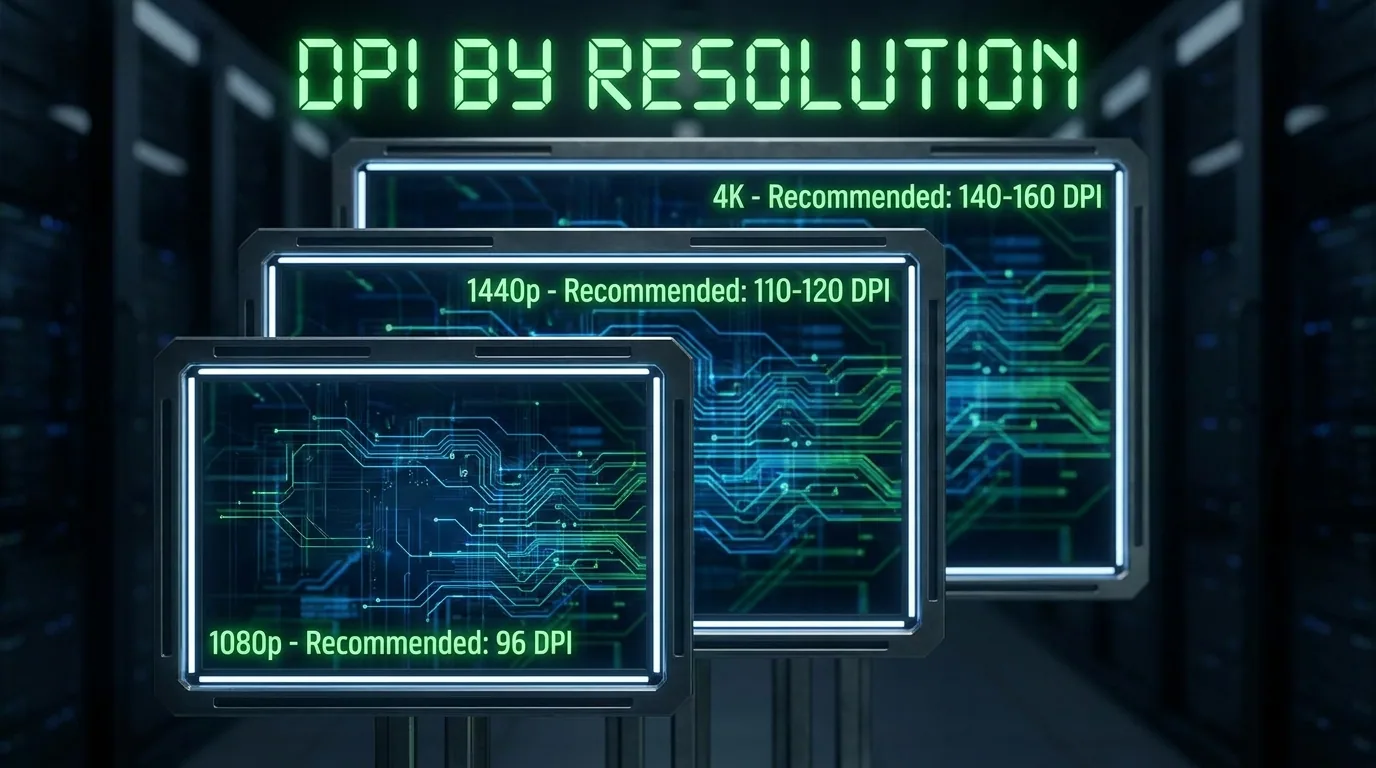
Does Monitor Resolution Change Your Sensitivity?
Monitor resolution does NOT directly change your sensitivity. Your cm/360 is determined by DPI × in-game sensitivity — not by resolution. A 400 DPI player on 1080p has exactly the same physical aim speed as a 400 DPI player on 4K at equal in-game sensitivity. However, resolution indirectly affects how aim feels through pixel density and visual feedback.
How Resolution Affects Aim Feel
1080p — The Competitive Standard
Larger pixels make micro-adjustments appear snappier. Heads appear larger in pixels at equal distances, making them easier to click on. Recommended DPI: 400–800. Most VCT, FACEIT, and BLAST pros use 1080p or 1280×960 stretched.
1440p — The 2026 Sweet Spot
~78% more pixels than 1080p. Targets appear smaller (fewer pixels at equivalent distance), which can make sensitivity feel slightly lower. Some players increase sensitivity 5–10% after switching from 1080p — this is perceptual, not mathematical. Recommended: 800 DPI, 4000 Hz polling.
4K
Your DPI setting does not change for 4K. Increased visual clarity can slightly improve target acquisition. Most 4K players report needing a marginal perceptual sensitivity increase (5–8%) vs. 1080p. Rare in competitive due to GPU requirements.
Recommendations by Setup
| Monitor | DPI | Polling |
|---|---|---|
| 1080p 144–240 Hz | 400 or 800 | 1000 Hz |
| 1440p 240–360 Hz | 800 | 2000–4000 Hz |
| 1440p OLED 480 Hz | 800 | 4000–8000 Hz |
| 4K 240 Hz | 800–1600 | 4000 Hz |
The Key Rule: Keep cm/360 Constant
When switching monitors or changing DPI, always verify your cm/360 with our eDPI calculator. Your muscle memory is calibrated to physical centimeters, not pixels. If you change DPI, adjust in-game sensitivity inversely to maintain the same cm/360.
Mathematical Mechanics & Engine Formulas
Understanding aim physics requires breaking down how rendering engines calculate rotation vectors. In 3D space, mouse movement inputs map to angular rotation per count based on the game engine's specific yaw constant:
• CS2 / Source Engine Yaw Constant: 0.022° per count
• Apex Legends Yaw Constant: 0.022° per count
• Overwatch 2 Yaw Constant: 0.0066° per count
• Fortnite Yaw Constant: 0.005555° per count
• Formula: eDPI = Hardware DPI × In-Game Sensitivity
• Formula: cm/360 = (360 × 2.54) / (DPI × Sensitivity × Yaw)
By keeping your physical centimeters per 360 rotation (cm/360) consistent, you maintain identical physical hand travel across titles. However, when switching between different aspect ratios (16:9 vs 4:3 stretched) or vertical FOVs, you must apply 0% Monitor Distance Matching (Focal Length Scaling) to match optical tracking speed at screen center.
Esports Meta & Pro Player Benchmark Data
Looking at publicly available pro settings and general esports sensitivity trends:
- Tactical Shooters (Valorant / CS2): The median pro eDPI sits between 200 and 320 eDPI (approx. 40cm/360 to 65cm/360). Pro players prefer lower sensitivity to maximize micro-correction accuracy and first-bullet headshot precision.
- Tracking & Dynamic Shooters (Apex / OW2 / Fortnite): The median pro eDPI ranges from 2400 to 4800 eDPI in Source/OW2 terms (approx. 28cm/360 to 38cm/360). Higher sensitivity allows rapid 180° sweeps and smooth target tracking during erratic movement.
Step-by-Step Calibration & Actionable Implementation
- Disable Windows Mouse Acceleration: Open Windows Control Panel → Mouse Properties → Pointer Options → Uncheck "Enhance Pointer Precision". This ensures 1:1 raw input without non-linear velocity scaling.
- Set Native Mouse DPI: Use 800 or 1600 DPI on modern optical sensors (PMW3395 / HERO 25K) to minimize sensor input latency by up to 2.5ms compared to 400 DPI while avoiding sensor smoothing.
- Calibrate Desk Space: Ensure your mousepad offers at least 450mm × 400mm of dynamic space. Your cm/360 should allow a full 180° turn from center to pad edge without lifting.
- Verify in Aim Trainers: Benchmark your target acquisition in KovaaK's or Aim Lab (Gridshot / Microflex) for 15 minutes to confirm zero overshoot or undershoot before entering ranked queues.
Frequently Asked Questions (FAQ)
Is higher DPI always better for aim?
Higher DPI (such as 1600 DPI) reduces input latency because the sensor sends motion packets more frequently per millimeter. However, going above 3200 DPI can introduce unwanted sensor noise or smoothing on certain optical sensors.
Should I match my hipfire sensitivity to my ADS sensitivity?
Yes! Utilizing 1:1 focal matching (0.847 in Valorant, 1.0 in CS2/Apex) aligns your focal muscle memory between hipfire aiming and scoped targeting.
Frequently Asked Questions
Should DPI change with monitor resolution?
For gaming, no. Your in-game sensitivity is computed from DPI and yaw, not from pixel count, so cm/360 is identical at 1080p and 4K. The idea that higher resolution needs higher DPI comes from desktop cursor movement, where it is true, and does not carry over.
Why does aiming feel different at a higher resolution?
Because targets render smaller and sharper, so the same physical movement covers what looks like less of the target. Nothing about the sensitivity changed — your visual reference did. Give it a week rather than adjusting the number.
What DPI should I use?
400, 800 or 1600 are the safe choices on any modern sensor, and 800 is the most common. What matters is that DPI x sensitivity gives you a cm/360 you can execute, not the DPI value itself.
🎯 Lock In Perfect 1:1 Aim & Pro Consistency
Tired of daily aim inconsistency? Calibrate your physical cm/360, scope matching, and sensor latency. Get the complete Precision Aim System (4-Part Technical Manifestos) today for only $9.00 USD!
Unlock Elite Precision ($9) ⚡Dalto Outlier
Creator, DCPROSENSDalto built DCPROSENS to help competitive FPS players convert sensitivity, calibrate DPI, and keep their aim consistent across games.
Related Guides & Articles
Disclosure: some links on this page are affiliate links. As an Amazon Associate, DCPROSENS earns from qualifying purchases at no extra cost to you.