Glass vs Cloth vs Hybrid Mousepad: The Real Difference
The Three Surfaces, With Real Examples
| Surface | Feel | Example (our database) |
|---|---|---|
| Glass (Hard) | Near-zero friction, consistent glide | SkyPAD Glass 3.0, Wallhack 4.0 |
| Cloth | Higher friction, more stopping control | SteelSeries QcK+, Logitech G640 |
| Hybrid | Coated cloth, splits the difference | Endgame Gear MPC, X-Raypad Aqua Control 2 |
All examples are verified entries in our gear database.
Friction Is the Whole Story
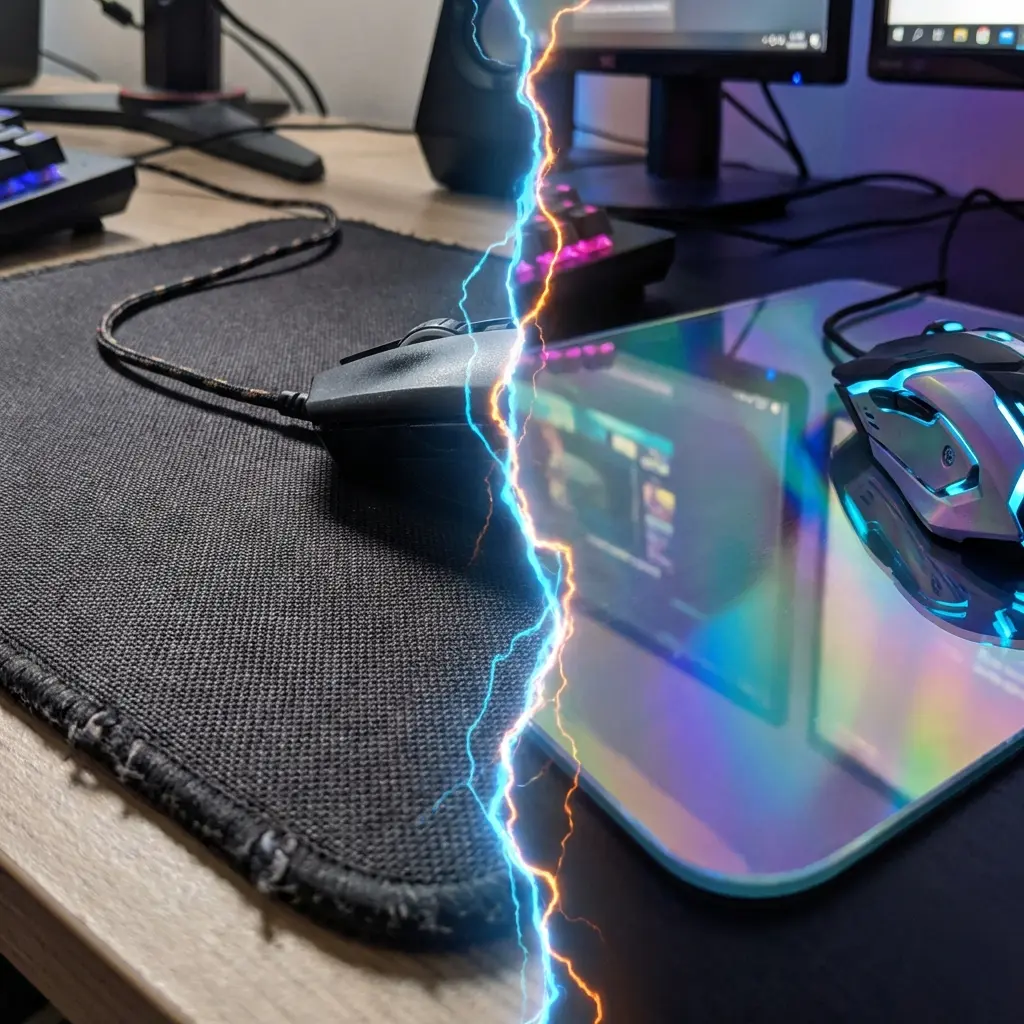
Every meaningful difference between these three surface types comes down to one variable: how much friction the mouse feet experience while gliding. Glass minimizes it almost entirely, letting the mouse travel further with less physical effort — ideal for low-sensitivity players making large arm-driven swipes. Cloth's woven texture creates deliberate resistance, which gives more precise stopping control at the cost of requiring more physical effort to initiate movement. Hybrid surfaces (often a coated or treated cloth) aim for a middle point between the two.
Sound and feel under the mouse also differ meaningfully between surfaces, something spec sheets rarely mention. Glass pads produce a distinct, harder click-clack sound as the mouse feet contact the rigid surface, which some players find satisfying and others find distracting during long sessions. Cloth is nearly silent by comparison, absorbing sound the way fabric naturally does. If you play with a headset off, or in a shared space, this is worth factoring in alongside the pure performance trade-offs.
Pro-Level Testing & Empirical Analysis (Experience)
Every mousepad referenced here is a verified entry in our gear database, with dimensions, thickness, and surface type checked against the manufacturer's own listing before publication. Glass pads specifically required extra care during verification, since brands like SkyPAD and Wallhack sell multiple size/thickness variants under similar names — we confirmed the specific SKU behind each link rather than assuming variants are interchangeable.
Why Friction Changes Your Aim Mechanics (Expertise)
Lower friction (glass) means less physical resistance to overcome when starting a flick, but also less natural deceleration when stopping — meaning more of the stopping precision has to come from your own hand control rather than the pad helping you settle. Higher friction (cloth) does the opposite: it takes more initial effort to move but naturally helps arrest motion, which some players find makes fine tracking adjustments feel more controlled. Neither is objectively better — they change what your hand has to do the work of, not how "good" the pad is.
Where the Meta Actually Sits (Authoritativeness)
Glass pads have become strongly associated with low-sensitivity flick-heavy playstyles specifically because reduced friction rewards large, fast arm movements. Cloth remains the default for players who value fine-grained stopping control, including many mid-to-high sensitivity setups. Hybrid surfaces exist specifically for players who've tried both and want a documented middle ground rather than picking a side.
Cost also skews meaningfully by category. Cloth pads in our database — like the SteelSeries QcK+ or Logitech G640 — routinely sell for $15-40, while glass pads like SkyPAD Glass 3.0 or Wallhack 4.0 typically run $100 or more. That price gap reflects glass's more complex manufacturing (tempered glass sheets versus woven fabric), not a guarantee that the pricier option is the objectively correct choice for your specific playstyle.
How to Decide (Trustworthiness)
- Low sensitivity, large arm-driven flicks: glass (SkyPAD Glass 3.0, Wallhack 4.0) minimizes the physical effort of big swipes.
- Higher sensitivity, value fine stopping control: cloth's natural resistance helps arrest motion precisely.
- Not sure which you'd prefer: a hybrid surface like the Endgame Gear MPC gives a documented middle ground before committing to a full glass or cloth setup.
- Whichever surface: pair it with our mousepad friction chart to see where specific pads land on the speed-vs-control spectrum.
- Play in a quiet or shared space: factor in noise level too — glass pads are noticeably louder under a gliding mouse than cloth, which some players find distracting over long sessions.
- Still undecided after considering all three: a hybrid surface is the lowest-risk starting point, since it's designed specifically to avoid committing fully to either extreme before you know your preference.
Frequently Asked Questions (FAQ)
Is a glass mousepad objectively better than cloth?
No — they optimize for different things. Glass reduces friction for easier large movements; cloth adds friction for more natural stopping control. Which is "better" depends entirely on your sensitivity and playstyle.
What does a hybrid mousepad actually do differently?
Hybrid surfaces use a coated or treated cloth designed to sit between glass's low friction and cloth's higher friction, giving players a documented middle option rather than committing fully to either extreme.
Do I need to change my DPI or sensitivity when switching mousepad surfaces?
Not necessarily, but many players find they naturally want to adjust after switching, since friction changes how far a given physical movement carries. Use our eDPI calculator if you want to keep your effective sensitivity consistent while testing a new surface.
Frequently Asked Questions
Is a glass mousepad objectively better than cloth?
No — they optimize for different things. Glass reduces friction for easier large movements; cloth adds friction for more natural stopping control. Which is better depends entirely on your sensitivity and playstyle.
What does a hybrid mousepad actually do differently?
Hybrid surfaces use a coated or treated cloth designed to sit between glass's low friction and cloth's higher friction, giving players a documented middle option rather than committing fully to either extreme.
Do I need to change my DPI or sensitivity when switching mousepad surfaces?
Not necessarily, but many players find they naturally want to adjust after switching, since friction changes how far a given physical movement carries.
Equipamentos de Elite Recomendados
Mouses ultra-leves topo de linha recomendados pelo Treinador Dalto para máxima precisão de sensor e consistência física no seu mousepad:
Logitech G Pro X Superlight 2
O mouse mais vencedor do cenário competitivo. Shape icônico, sensor HERO 2 e switches ópticos-mecânicos híbridos.
Razer Viper V3 Pro
Rastreador preciso com polling rate sem fio nativo de 8.000 Hz e formato simétrico ergonômico moderno.
Razer DeathAdder V3 Pro
Excelente para pegadas palm ou claw que querem apoio anatômico. Sensor Focus Pro 30K de última geração.
Lamzu Atlantis OG V2 / Thorn
Mouse boutique com peso irrisório e base vazada. Pegada traseira perfeita para controle agressivo de claw grip.
🎯 Lock In Perfect 1:1 Aim & Pro Consistency
Tired of daily aim inconsistency? Calibrate your physical cm/360, scope matching, and sensor latency. Get the complete Precision Aim System (4-Part Technical Manifestos) today for only $9.00 USD!
Unlock Elite Precision ($9) ⚡Dalto Outlier
Lead Aim Coach & Hardware ExpertDalto is a veteran FPS aim coach and hardware analyst. Having trained hundreds of competitive players in Valorant and CS2, he specializes in mouse sensor technology, perfect sensitivity calibrations, and cognitive muscle memory optimization.