

OLED Motion Clarity vs 360Hz Fast IPS: Response Time vs Refresh Rate
TL;DR
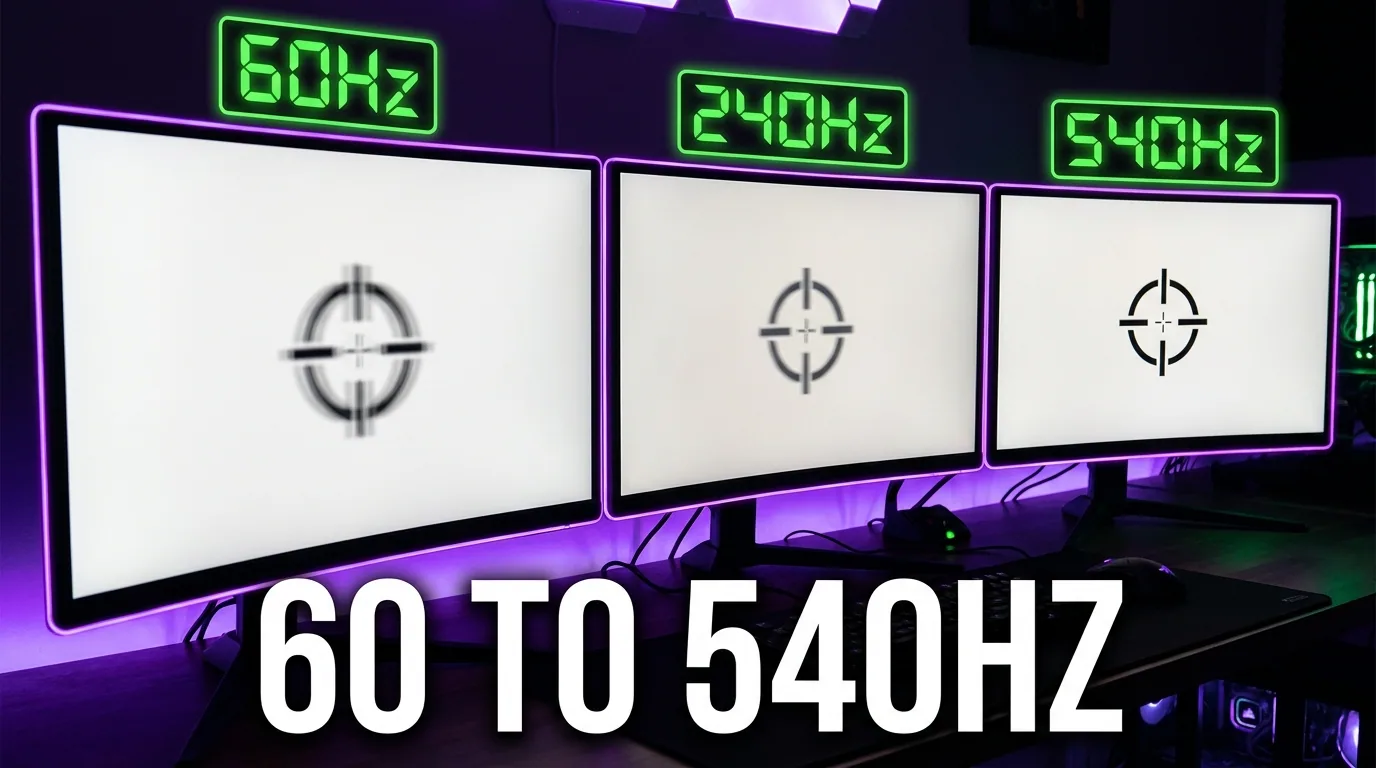
OLED displays deliver near-instantaneous 0.03ms pixel response times that eliminate color ghosting and inverse trails. However, human retinal eye tracking creates motion blur on all sample-and-hold screens, making 360Hz/540Hz IPS competitive for fast target tracking.


Pixel Response Time vs Eye-Tracking Persistence
To evaluate gaming monitors correctly, competitive players must separate two completely distinct technical phenomena:
- Pixel Response Time (GtG - Grey to Grey): How quickly an individual LCD crystal or organic diode changes state. Slow pixel response causes ghosting, smear trails, and corona overshoot artifacts.
- Sample-and-Hold Motion Blur (MPRT): Motion blur caused by the human eye smoothly tracking an object across the screen while the display holds each frame static until the next refresh.
While OLED panels virtually eliminate pixel transition time (dropping from ~2.0ms on Fast IPS down to 0.03ms on OLED), they remain sample-and-hold displays. True blur elimination requires either higher refresh rates or backlight strobing (BFI).
Clarity Benchmark Matrix
| Panel Technology | Pixel GtG Speed | Frame Persistence (MPRT) | Motion Artifacts |
|---|---|---|---|
| 240Hz QD-OLED / WOLED | ~0.03 ms | 4.16 ms | Zero ghosting, infinite contrast |
| 360Hz Fast IPS | ~1.5 to 2.8 ms | 2.77 ms | Slight trailing on dark transitions |
| 540Hz Fast TN (e.g. DyAc 2) | ~0.8 ms | < 1.0 ms (Strobed) | Maximum CRT-like sharpness; lower contrast |
| 480Hz Tandem OLED | ~0.02 ms | 2.08 ms | Flawless competitive clarity benchmark |
Which Display Suits Your Playstyle?
- Choose 240Hz/360Hz OLED If: You want peerless visual clarity, instant dark-to-light transitions with zero inverse ghosting, and exceptional contrast for tracking heads through smoke and shadow areas.
- Choose 540Hz Strobed LCD (DyAc) If: You are a tier-1 tactical shooter specialist whose only priority is CRT-grade motion clarity during aggressive camera pans.
Before competing, make sure your in-game sensitivity is synchronized using the DCPROSENS Universal Aim Calculator.
Eliminate Frame Tears, Pacing Stutters & Display Lag
Master display refresh caps, G-Sync pipelines, and frame delivery in our FPS & Input Lag Playbook, or configure your competitive battle station in the VIP 1:1 Overhaul.
Frequently Asked Questions
Why is there still blur on OLED when pixel response is 0.03ms?
Retinal tracking persistence (sample-and-hold motion blur). When your eyes track a moving object across static frame presentations, the image smears across your retina until refreshed.
Does 240Hz OLED have better motion clarity than 360Hz Fast IPS?
In pursuit camera tests (Blur Busters UFO test), a 240Hz OLED delivers motion clarity comparable to or slightly sharper than a 360Hz IPS because OLED has zero pixel rise/fall trailing.
Is burn-in a serious concern for competitive FPS players?
Static HUD elements like health bars and minimaps can cause burn-in over thousands of hours on early OLEDs. Modern QD-OLED and WOLED panels use pixel shift and heatsinks to drastically mitigate this risk.
🎯 Lock In Perfect 1:1 Aim & Pro Consistency
Tired of daily aim inconsistency? Calibrate your physical cm/360, scope matching, and sensor latency. Get the complete Precision Aim System (4-Part Technical Manifestos) today for only $9.00 USD!
Unlock Elite Precision ($9) ⚡Dalto Outlier
Creator, DCPROSENSDalto built DCPROSENS to help competitive FPS players convert sensitivity, calibrate DPI, and keep their aim consistent across games.
Related Guides & Articles
Disclosure: some links on this page are affiliate links. As an Amazon Associate, DCPROSENS earns from qualifying purchases at no extra cost to you.

