Overwatch 2 Ranking System Explained (2026)
TL;DR
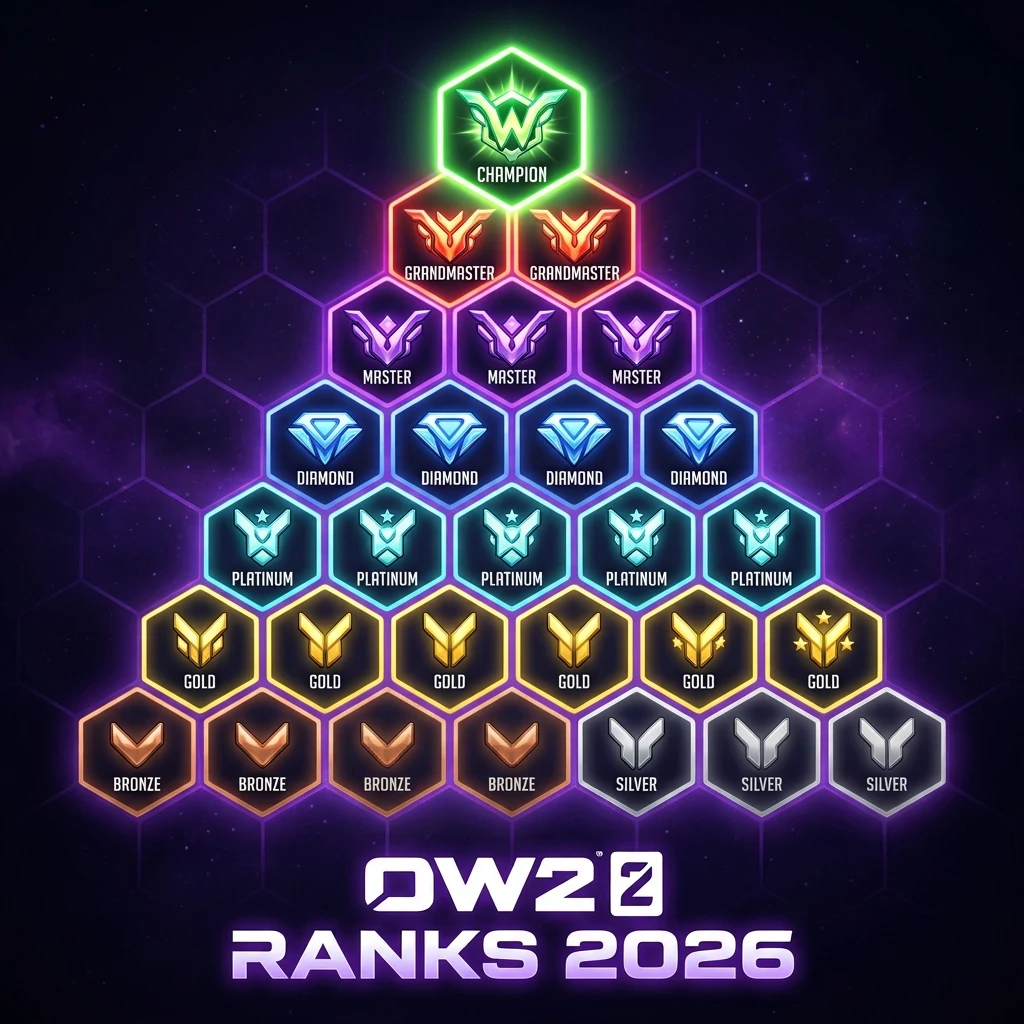
Overwatch 2's competitive mode has eight tiers — Bronze, Silver, Gold, Platinum, Diamond, Master, Grandmaster, and Champion — each split into five divisions, for 40 total ranked steps, with Top 500 above that as a per-role leaderboard rather than a tier. Since Season 9, Tank, Damage, and Support each carry a fully separate SR (0–5000+), and your rank updates after every single match instead of in batches.
Full Rank Tiers
Overwatch 2 has eight skill tiers, from lowest to highest: Bronze, Silver, Gold, Platinum, Diamond, Master, Grandmaster, and Champion — Champion was added at the very top of the ladder starting in Season 9. Each of these eight tiers is split into five divisions, numbered 5 (lowest) down to 1 (highest) within that tier, so you climb Gold 5 → Gold 4 → Gold 3 → Gold 2 → Gold 1 before crossing into Platinum 5. That structure gives 40 total ranked steps across the eight tiers.
Above Champion sits Top 500 — not a rank tier itself, but a per-role, per-region leaderboard of the 500 highest-rated players for that specific role and region. Reaching Top 500 means out-rating everyone else on that specific leaderboard, not clearing a fixed SR threshold the way climbing through the eight named tiers does.
| Tier (low to high) | Divisions |
|---|---|
| Bronze | 5 → 1 |
| Silver | 5 → 1 |
| Gold | 5 → 1 |
| Platinum | 5 → 1 |
| Diamond | 5 → 1 |
| Master | 5 → 1 |
| Grandmaster | 5 → 1 |
| Champion | 5 → 1 (top named tier) |
| Top 500 | Leaderboard, not a tier — per role/region |
Role-Based SR/Rank Explained
Overwatch 2 uses Role Queue: before every match you select Tank, Damage, or Support, and you play exclusively that role for the duration of the game. Since Season 9's ranking rework, each of the three roles carries its own fully separate SR (Skill Rating), on a scale roughly from 0 to 5000+. It's entirely normal — and common — for a player to sit at a meaningfully different rank in each role; a player might be Diamond as Support but only Gold as Tank, and that gap simply reflects genuinely different proficiency and experience in each role rather than a bug or an outlier case.
SR movement per match isn't a straightforward function of your individual stat line. Gains and losses depend on factors including win/loss streaks, the rating of the opposing team, and the broader population within that role's queue — a strong personal performance in a loss doesn't directly inflate your SR the way it might in a game with individual performance-based rating adjustments, since Overwatch 2's competitive system weights team outcome heavily. Since the Season 9 rework (February 2024), your rank updates after every single match rather than only revealing a change after a batch of games, and the post-match screen now shows explicit modifiers explaining why your SR moved the amount it did.
How Placement Matches Actually Set Your Starting Rank
Placement matches aren't scored like a normal ranked game with a simple win-or-lose SR swing — they're a calibration window where the system is trying to locate your true skill level as efficiently as possible, which is why a single placement loss can move your provisional rank by a much larger amount than a single loss would later in the season. Prior-season performance history factors into where your placements start you off, but it's not a guarantee: a player coming off a strong finish the previous season can still land somewhat lower after a rough set of placement games, since the fresh results carry real weight in that recalibration rather than being purely a formality.
This is also why the common advice to "take placements seriously" is more than superstition — because the swings during this window are larger and more consequential than a typical mid-season match, a handful of placement losses in a row can meaningfully undershoot your actual skill level for the rest of the season, requiring extra wins later just to correct back to where a more careful placement run would have landed you immediately.
Season Reset Behavior
Each new competitive season introduces a soft reset: your visible rank can drop somewhat at the start of a new season even if your actual skill hasn't changed, and you'll need to play a fresh set of placement matches — typically 5 to 7 per role in the current system — to re-establish your starting rank for that season. Placement matches use your prior performance history as a starting signal but still require the fresh games to confirm where you land, so a strong finish in one season doesn't guarantee an identical rank the instant the next one begins.
Separately from seasonal resets, Overwatch 2 also applies inactivity-based rank decay, but only above a certain skill level: players sitting at Master rank or above who go 14 consecutive days without a ranked match begin losing SR automatically, at a rate of roughly 50 SR per day of continued inactivity, accelerating the longer the break lasts. Diamond and below are exempt from this decay entirely, so casual and lower-ranked players can take extended breaks without their visible rank slipping. Decay only affects your visible tier, not your underlying hidden MMR, and a handful of matches in each role is enough to restore it once you're back.
If you're bringing your aim over from another game, get your sensitivity converted accurately first with the Overwatch 2 sensitivity converter, and warm up your tracking specifically before a competitive session with the free DCPROSENS Aim Trainer — Overwatch 2's hero-shooter pace rewards sustained tracking more than pure flick accuracy on many heroes. For a comparably structured tier-and-division system in a different genre, see our companion guide on Rainbow Six Siege's ranking system.
Why Role-Specific SR Changed How Players Approach Ranked
Before ranks were split by role, a player's single combined rating had to represent their skill across every role they might get assigned, which tended to punish flexible players and reward those who mastered exactly one role and refused to play anything else. Splitting SR by role removed that penalty: a player can now genuinely be a specialist on one role and a beginner on another without either number dragging the other down, which is part of why role specialization (rather than trying to be equally competent everywhere) is generally the faster path to a high rank in at least one of the three roles.
It also changed how seriously to take a single number as a measure of "overall skill." Since Tank, Damage, and Support SR are earned independently, quoting just one of the three in isolation — "I'm Diamond" without specifying the role — tells you less than it used to, and most competitive discussion within the community now specifies role alongside rank for exactly this reason.
Comparing Overwatch 2's System to Other Role-Based Games
The eight-tier, five-division structure (40 total steps, plus a Top 500 leaderboard above that) is a common shape across several modern competitive shooters, not something unique to Overwatch 2 — Rainbow Six Siege's Ranked 3.0 system, covered in our companion guide on R6 Siege's ranks, follows the same eight-tier-times-five-division math even though the two games track skill through very different underlying formulas (role-separated SR with team-outcome weighting in Overwatch 2, versus a single TrueSkill-based MMR in Siege). Recognizing that shared shape is useful context: a Diamond rank in one game and a Diamond rank in the other aren't measuring the same underlying skill or population percentile, even though the tier name and division count line up almost exactly.
What's genuinely distinct to Overwatch 2 is the fully separate per-role rating combined with match-outcome-weighted (rather than individual-stat-weighted) SR movement — a combination that rewards consistent role specialization and team-focused play more directly than systems built around a single combined number or heavier individual-performance scoring.
Open Queue vs. Role Queue Ranked
Alongside standard Role Queue competitive, Overwatch 2 also runs a permanent Open Queue competitive playlist, where team composition isn't locked into the standard one-tank, two-damage, two-support split — players queue without a fixed role and teams can end up with any combination. Blizzard has also periodically tested Open Queue at a 6v6 team size rather than the standard 5v5 used in Role Queue, as a separate experiment layered on top of the open-composition idea. Open Queue tracks its own rank, entirely separate from Role Queue's three per-role ratings, since the underlying skill demands differ meaningfully — coordinating and adapting to a flexible, non-standard composition rewards different decision-making than optimizing performance within one fixed role slot every game. A player heavily specialized in Role Queue Support, for instance, doesn't automatically carry an equivalent rank into Open Queue, since the matchmaking pool and typical team compositions behave differently enough that the two ratings aren't meant to be directly comparable.
What Actually Moves the Needle When Climbing
Because SR swings are shaped by team outcome, streaks, and opponent rating rather than individual stat lines, the most reliable way to climb consistently is winning as many individual matches as possible rather than optimizing for a strong personal scoreboard in matches you still lose. This is a common point of confusion for players coming from games with more individual-performance-weighted rating systems, where a strong personal performance in a loss still meaningfully protects your rating — Overwatch 2's team-outcome-weighted model doesn't extend that same cushion nearly as generously.
Frequently Asked Questions
Frequently Asked Questions
How does Overwatch 2 rank decay work?
Only players at Master rank or above are affected. If you go 14 consecutive days without playing a competitive match, your SR begins decaying automatically at roughly 50 SR per day, accelerating the longer you stay inactive. Diamond and below don't decay, and playing a handful of matches restores your rank once you're back.
What's the difference between SR and rank tier?
SR (Skill Rating) is the underlying numeric score, roughly 0 to 5000+, that determines your exact standing within a role. Rank tier (Bronze through Champion, each with five divisions) is the visible label mapped to ranges of that SR — the tier is a human-readable summary of the number, not a separate system.
🎯 Lock In Perfect 1:1 Aim & Pro Consistency
Tired of daily aim inconsistency? Calibrate your physical cm/360, scope matching, and sensor latency. Get the complete Precision Aim System (4-Part Technical Manifestos) today for only $9.00 USD!
Unlock Elite Precision ($9) ⚡Dalto Outlier
Creator, DCPROSENSDalto built DCPROSENS to help competitive FPS players convert sensitivity, calibrate DPI, and keep their aim consistent across games.