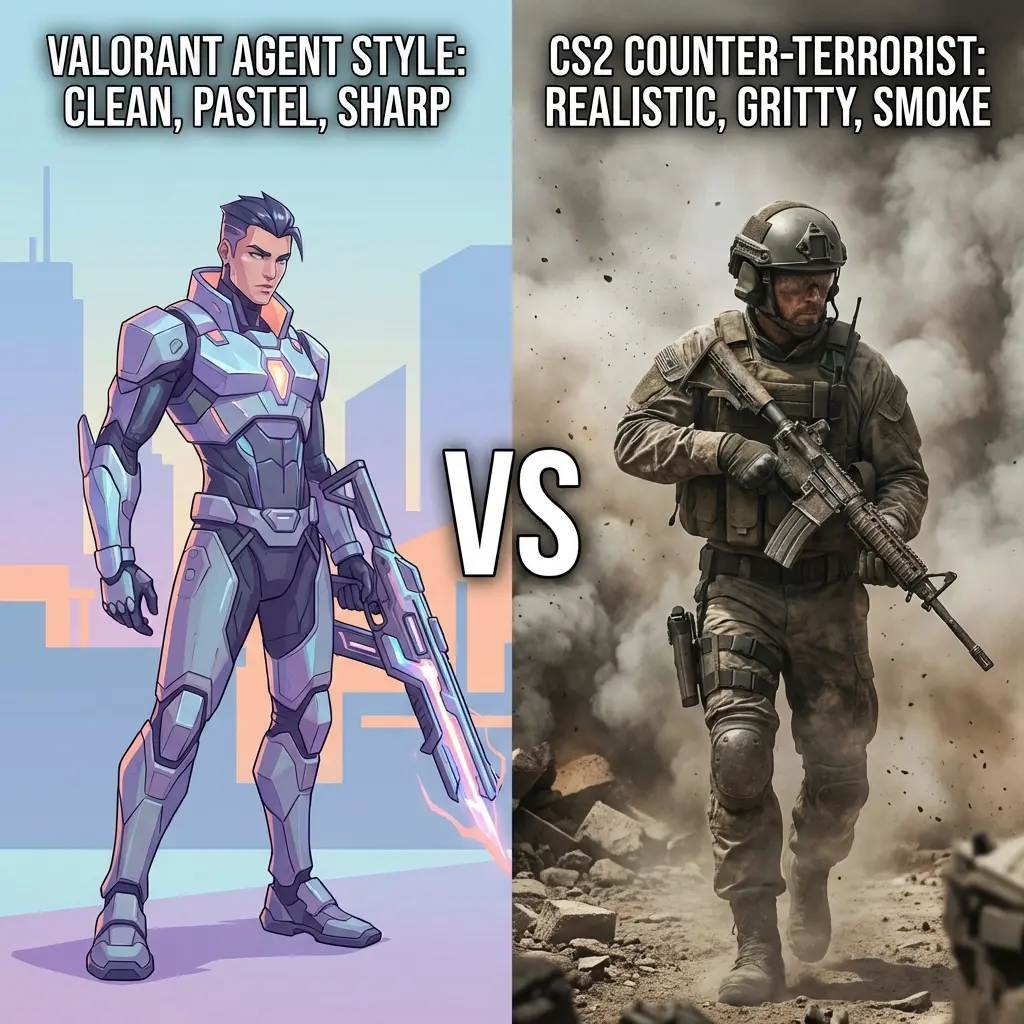
Valorant to CS2 Crosshair Converter
TL;DR
Unlike sensitivity, crosshair size and shape don't convert between Valorant and CS2 with a fixed mathematical formula, because the two games use entirely different crosshair rendering systems and parameter scales. The practical approach is matching visual proportions (relative size, thickness, and color) rather than searching for an exact numeric converter.
Why There's No Exact Crosshair Conversion Formula
Sensitivity converts cleanly between Valorant and CS2 because both games use the same underlying concept — a yaw constant multiplying raw mouse input — just with different numeric values. Crosshairs don't share that common structure. Valorant's crosshair system uses its own set of parameters (outline, center dot, inner/outer lines, firing error, movement error) on a 0–1 or 0–10 style scale specific to Valorant's UI, while CS2's crosshair system (inherited from the Source engine's cl_crosshair convars) uses entirely different parameters and numeric ranges. There is no shared constant to divide or multiply by, the way there is with yaw — which is exactly why no legitimate "exact" crosshair converter exists between the two games.
What You Can Actually Match
Instead of chasing an exact numeric conversion, match the visual proportions that actually matter for how the crosshair performs:
- Relative size on screen — how much of the target the crosshair visually covers at typical engagement distance, independent of each game's specific size units.
- Color — this one transfers directly; if you use bright cyan in Valorant, set the same bright cyan in CS2's crosshair color options (or the closest RGB match CS2's system allows).
- Static vs. dynamic behavior — whether the crosshair expands during movement/firing. Both games support a fully static crosshair, and matching this behavior matters more for consistency than matching exact size.
- Outline presence — if you rely on an outline for visibility against bright maps in one game, replicate that in the other rather than leaving it off by default.
Step-by-Step: Rebuilding Your Crosshair in the Second Game
- Take a screenshot of your crosshair at rest in your primary game, ideally against a plain, neutral background.
- Open the second game's crosshair generator (DCPROSENS's crosshair generator supports both) side by side with that screenshot.
- Match size first — adjust until the crosshair covers roughly the same proportion of a target's head/body at a similar in-game distance, not until the raw numbers match.
- Match thickness and gap next, using the same visual-proportion approach.
- Set matching color and outline, which transfer far more directly than size/shape.
- Disable dynamic crosshair behavior in both if you're using a static crosshair in either, for consistency.
Why Exact Visual Matching Is Worth the Effort
Crosshair placement — keeping your crosshair at head-level on likely enemy positions before you see them — is a trained visual habit, much like sensitivity is a trained physical one. A crosshair that looks and behaves noticeably differently between two games you regularly switch between forces your brain to re-calibrate that visual habit every time you swap, which is a real (if often underestimated) source of the "off" feeling players report right after switching games, separate from any sensitivity mismatch.
A Reasonable Baseline If You're Starting Fresh
If you don't already have a crosshair you like in either game, start from a real pro's published settings in your primary game (see our pro player database for current codes), then use the visual-matching process above to build the CS2 or Valorant equivalent rather than trying to find a matching pro crosshair in both games independently — most pros only optimize their crosshair for whichever single game they compete in.
Common Mistakes
- Assuming a "crosshair converter" tool gives an exact result. Because no shared formula exists, any tool claiming an exact numeric conversion between Valorant and CS2 crosshairs is applying a rough visual approximation at best, not real math — treat its output as a starting point to refine, not a final answer.
- Matching size only at point-blank range. Test your matched crosshair at typical mid-to-long engagement distances for each game, since that's where most real fights actually happen.
- Forgetting the outline setting, which has an outsized effect on visibility that's easy to overlook since it's not always the first setting shown in either game's crosshair menu.
Using a Pro's Settings as a Cross-Game Reference Point
Some professional players compete in both games at different points in their career, which makes their published settings across titles a genuinely useful reference for proportional matching rather than starting from nothing. If you can find a player's crosshair codes for both Valorant and CS2 specifically, comparing the two directly tells you how that specific player chose to translate their own preferences across engines — often a more reliable proportional guide than an average of many unrelated players' settings in each game separately. Our own pro database occasionally includes players with a documented history in both titles, worth checking before building entirely from scratch.
Valorant's Unique Crosshair Features CS2 Doesn't Have
Valorant's crosshair system includes a few parameters with no real CS2 equivalent — most notably separate firing error and movement error crosshair expansion, which visually show your actual accuracy penalty while moving or shooting. CS2's crosshair is purely a static visual reference with no built-in error-visualization feature. When rebuilding a Valorant crosshair in CS2, these settings simply have nothing to match — focus the conversion effort on the core shared parameters (size, thickness, gap, color, outline) rather than searching for a CS2 setting that doesn't exist, since it genuinely was never part of that game's crosshair system to begin with.
Saving and Re-Using Your Matched Setup
Once you've built a crosshair you're happy with in both games, save the exported code or config line somewhere outside either game — a notes file, a personal wiki, or a bookmarked page from a crosshair generator that lets you reload a saved code. Both games can reset visual settings after major updates or a fresh install, and rebuilding a carefully proportion-matched crosshair pair from memory is far more error-prone than re-importing a saved code.
Revisiting Your Match After a Setup Change
A proportional crosshair match is tied to the specific resolution and monitor size you built it on. Upgrading to a new monitor, switching resolutions, or changing aspect ratio (including moving to or from a stretched resolution) all shift the visual proportions your matched crosshair was based on. Treat any of these changes as a trigger to redo the visual-matching process rather than assuming a crosshair that matched well before will still match after — the underlying games haven't changed, but your display has, and that's usually enough to notice.
Third-Person and Alternate Game Modes
Both Valorant and CS2 occasionally feature limited-time or alternate modes with different camera behavior (replay cameras, spectator views, or special event modes). Crosshair matching as described in this guide applies specifically to standard first-person competitive play — don't worry too much about matching proportions for modes where precise crosshair placement isn't the primary skill being tested.
Putting It All Together
Matching a crosshair across Valorant and CS2 will never be as mathematically clean as converting sensitivity, simply because the two games weren't built on a shared visual system the way they share a linear yaw-based camera model. Treat the process as building two crosshairs that look and behave the same way to your eyes, refined through real testing, rather than searching for a converter that promises an exact answer neither game's engine can actually support. Once matched, the small remaining differences become background noise you stop consciously noticing within a few real sessions.
Frequently Asked Questions
Is there an exact formula to convert crosshair settings between Valorant and CS2?
No. Unlike sensitivity, the two games use entirely different crosshair systems with no shared underlying constant, so there is no exact mathematical conversion — matching visual proportions (size, color, static behavior) is the practical approach.
Why does my crosshair feel different after switching games even with a "matched" setup?
Because crosshair matching is a visual approximation, not exact math, small proportional differences are common even after careful matching. It's normal to need a short re-adjustment period, though far shorter than starting from scratch.
Should I use the same crosshair color in both games?
Yes — color is one of the few crosshair properties that transfers directly and exactly, and keeping it consistent removes one variable from the visual re-calibration needed when switching games.
Can I import a Valorant crosshair code directly into CS2?
No — the two games use completely incompatible code/config formats specific to their own crosshair systems. You'll need to manually rebuild the crosshair in CS2's own settings or config file using the visual-matching approach.
🎯 Lock In Perfect 1:1 Aim & Pro Consistency
Tired of daily aim inconsistency? Calibrate your physical cm/360, scope matching, and sensor latency. Get the complete Precision Aim System (4-Part Technical Manifestos) today for only $9.00 USD!
Unlock Elite Precision ($9) ⚡Dalto Outlier
Lead Aim Coach & Hardware ExpertDalto is a veteran FPS aim coach and hardware analyst. Having trained hundreds of competitive players in Valorant and CS2, he specializes in mouse sensor technology, perfect sensitivity calibrations, and cognitive muscle memory optimization.