Rapid Trigger & Analog Keyboards Explained
The Mechanics of Stopping Instantly
In tactical shooters like CS2 and Valorant, your weapons have severe movement penalties. If you fire while moving even a fraction of a meter, your bullets fly wildly off target. To hit a headshot, your character must be completely still the millisecond you click the mouse. This is achieved via a technique called **Counter-Strafing** (tapping the opposite movement key to cancel velocity instantly).
However, traditional mechanical keyboards introduce a mechanical delay. When you release the 'A' key, the physical switch must travel back past its **deactivation point** before the keyboard registers that you stopped. This mechanical latency (typically 1.5ms to 3ms) delays your counter-strafe, making your first bullet inaccurate.
Enter the Hall Effect: Rapid Trigger
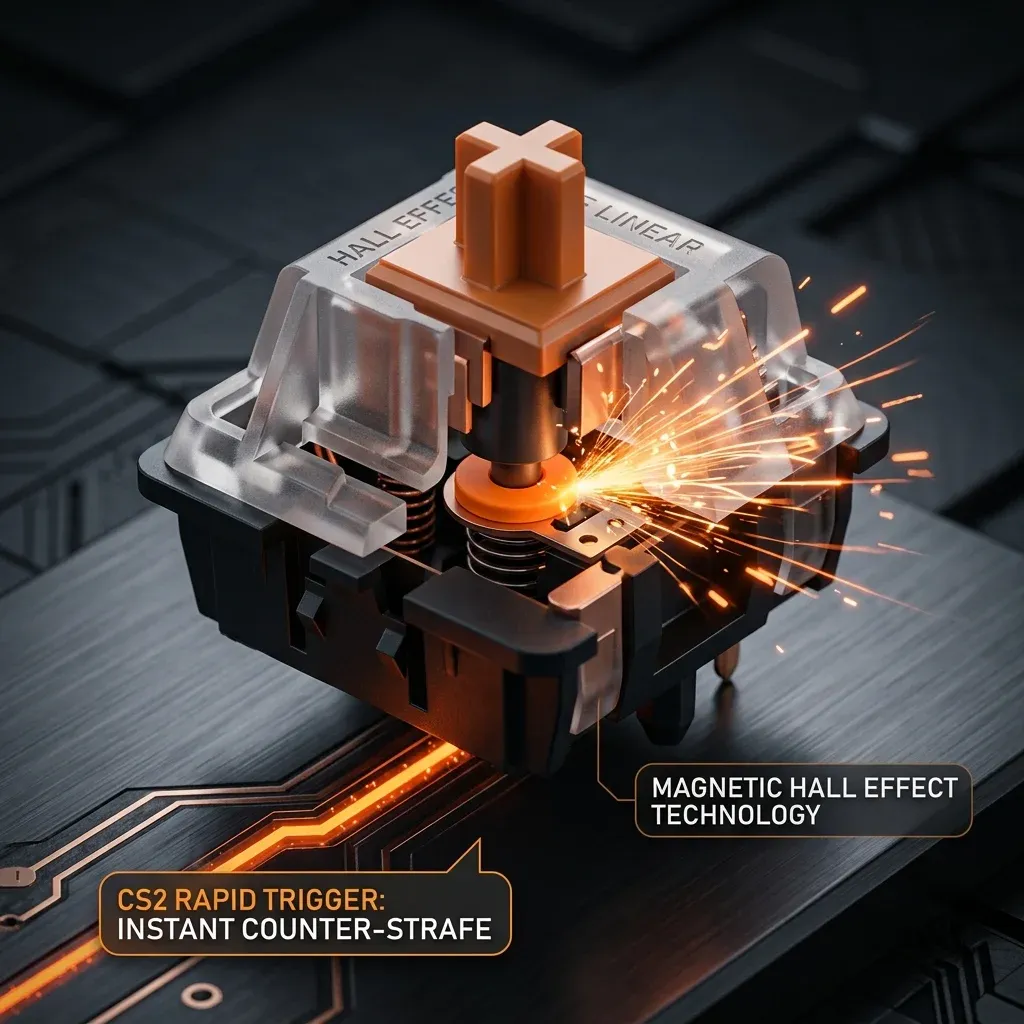
Analog magnetic keyboards (like the Wooting 60HE or Razer Huntsman V3 Pro TKL) completely eliminate this delay using **Hall Effect sensors**. Instead of a physical metal contact, a magnet measures the exact travel distance of the key continuously.
With a software feature called **Rapid Trigger**, the key input resets the **exact instant** the switch begins moving upward, even by a fraction of a millimeter. You no longer have to wait for the key to reset past a fixed point. When you release the key, your character stops moving on screen instantly.
How Rapid Trigger Transforms Aiming
Movement and aiming are not separate skills—they are deeply intertwined. When you peek an angle, your eyes track the target while your hands coordinate the movement. If your character stops 50ms later than expected due to mechanical switch latency, your crosshair will overshoot, and you will fire before your velocity resets to 0%.
Rapid Trigger guarantees that your movement cancels precisely when your brain coordinates it. This makes pre-aiming corners and peeking angles exceptionally sharp, clean, and consistent.
Mastering the Integrated Aim-Movement Loop
To fully capitalize on advanced hardware like magnetic keyboards, you must train your hands to coordinate movement stop triggers and mouse clicks in perfect synchronization. If you want to master high-level peeking geometry and counter-strafe coordination, check out our premium Precision Aim System (4-Part Technical Manifestos). System 2 ("Perfect Crosshair Placement") and System 3 ("Neuro-Muscular Aim Conditioning") break down advanced movement isolation training models to maximize your hardware advantage.
Mathematical Mechanics & Engine Formulas
Understanding aim physics requires breaking down how rendering engines calculate rotation vectors. In 3D space, mouse movement inputs map to angular rotation per count based on the game engine's specific yaw constant:
• CS2 / Source Engine Yaw Constant: 0.022° per count
• Apex Legends Yaw Constant: 0.022° per count
• Overwatch 2 Yaw Constant: 0.0066° per count
• Fortnite Yaw Constant: 0.005555° per count
• Formula: eDPI = Hardware DPI × In-Game Sensitivity
• Formula: cm/360 = (360 × 2.54) / (DPI × Sensitivity × Yaw)
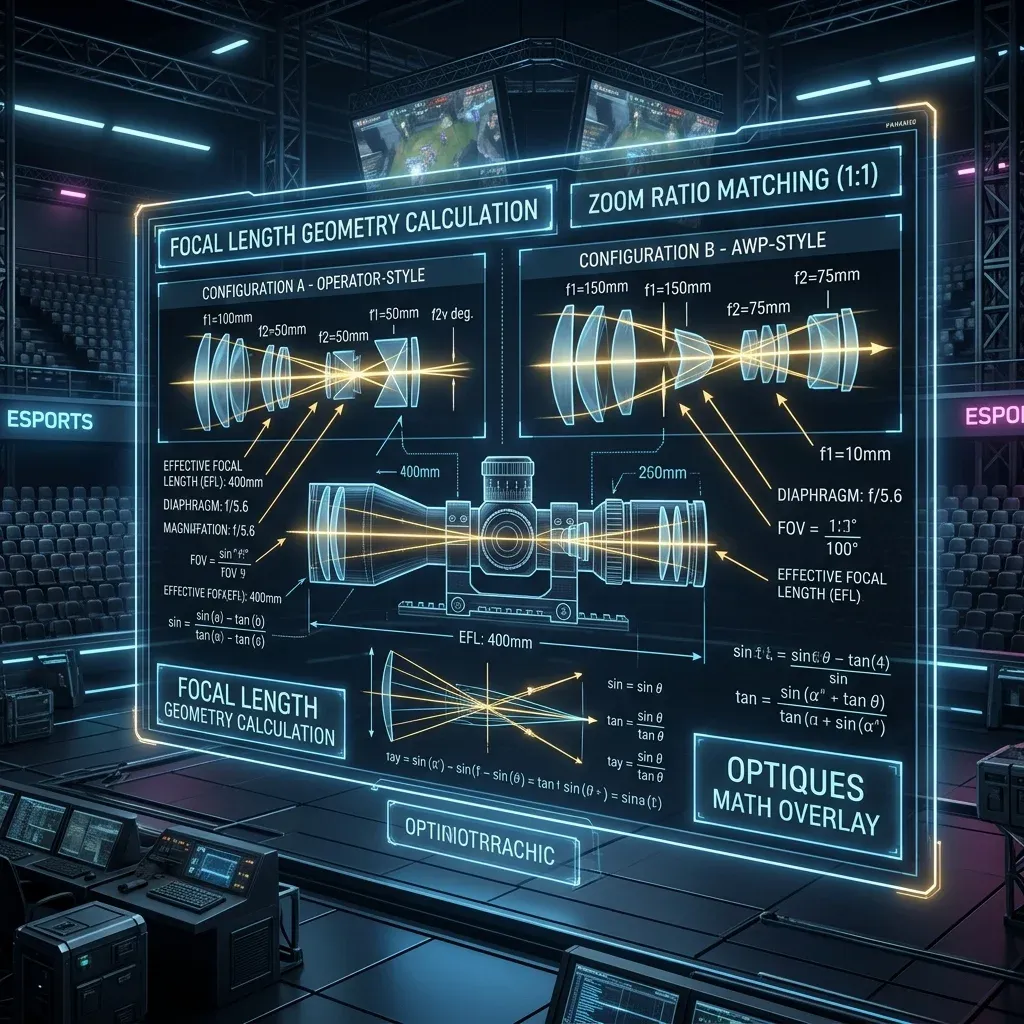
By keeping your physical centimeters per 360 rotation (cm/360) consistent, you maintain identical physical hand travel across titles. However, when switching between different aspect ratios (16:9 vs 4:3 stretched) or vertical FOVs, you must apply 0% Monitor Distance Matching (Focal Length Scaling) to match optical tracking speed at screen center.
Esports Meta & Pro Player Benchmark Data
Looking at publicly available pro settings and general esports sensitivity trends:
- Tactical Shooters (Valorant / CS2): The median pro eDPI sits between 200 and 320 eDPI (approx. 40cm/360 to 65cm/360). Pro players prefer lower sensitivity to maximize micro-correction accuracy and first-bullet headshot precision.
- Tracking & Dynamic Shooters (Apex / OW2 / Fortnite): The median pro eDPI ranges from 2400 to 4800 eDPI in Source/OW2 terms (approx. 28cm/360 to 38cm/360). Higher sensitivity allows rapid 180° sweeps and smooth target tracking during erratic movement.
Step-by-Step Calibration & Actionable Implementation
- Disable Windows Mouse Acceleration: Open Windows Control Panel → Mouse Properties → Pointer Options → Uncheck "Enhance Pointer Precision". This ensures 1:1 raw input without non-linear velocity scaling.
- Set Native Mouse DPI: Use 800 or 1600 DPI on modern optical sensors (PMW3395 / HERO 25K) to minimize sensor input latency by up to 2.5ms compared to 400 DPI while avoiding sensor smoothing.
- Calibrate Desk Space: Ensure your mousepad offers at least 450mm × 400mm of dynamic space. Your cm/360 should allow a full 180° turn from center to pad edge without lifting.
- Verify in Aim Trainers: Benchmark your target acquisition in KovaaK's or Aim Lab (Gridshot / Microflex) for 15 minutes to confirm zero overshoot or undershoot before entering ranked queues.
Frequently Asked Questions (FAQ)
Is higher DPI always better for aim?
Higher DPI (such as 1600 DPI) reduces input latency because the sensor sends motion packets more frequently per millimeter. However, going above 3200 DPI can introduce unwanted sensor noise or smoothing on certain optical sensors.
Should I match my hipfire sensitivity to my ADS sensitivity?
Yes! Utilizing 1:1 focal matching (0.847 in Valorant, 1.0 in CS2/Apex) aligns your focal muscle memory between hipfire aiming and scoped targeting.
🎯 Lock In Perfect 1:1 Aim & Pro Consistency
Tired of daily aim inconsistency? Calibrate your physical cm/360, scope matching, and sensor latency. Get the complete Precision Aim System (4-Part Technical Manifestos) today for only $9.00 USD!
Unlock Elite Precision ($9) ⚡Dalto Outlier
Creator, DCPROSENSDalto built DCPROSENS to help competitive FPS players convert sensitivity, calibrate DPI, and keep their aim consistent across games.