

Better Aim Trainer Scores, Same Match Results? Try This
TL;DR
A higher aim-trainer score shows improvement on that task, not automatic improvement in every match situation. Identify one recurring in-game mistake, choose a drill that resembles it and evaluate the same behavior in-game. Keep trainer scores and match observations as separate measures.


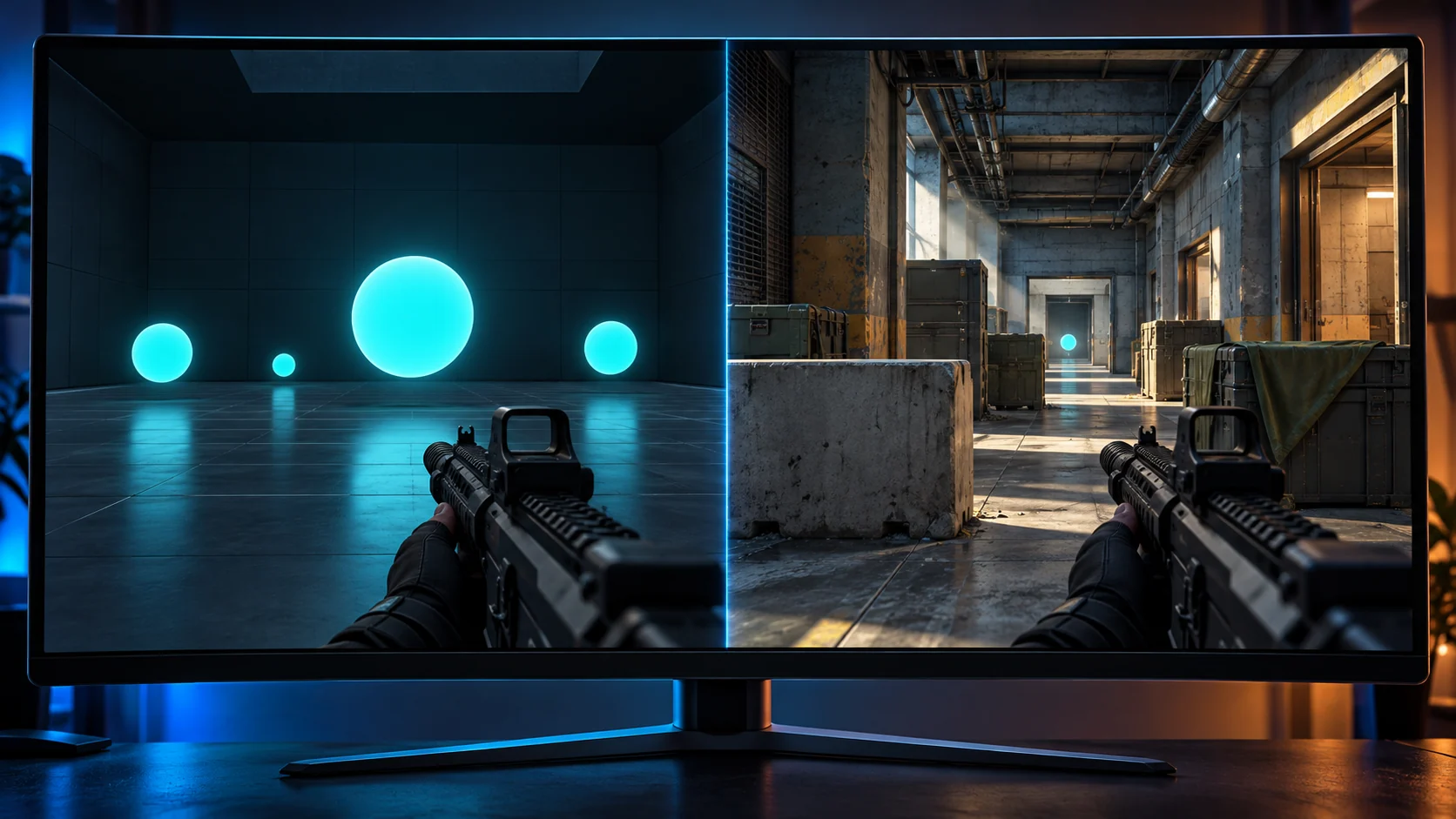
Original concept scene, not a screenshot from a specific game or trainer.
You beat a personal best, enter a match and still lose the same kind of duel. That does not make the practice worthless. It means the score alone has not explained the problem you want to solve.
A shooting task can test rapid target selection while your match problem is starting with the crosshair too low. Another task can reward continuous tracking while your game requires a brief accurate correction after stopping movement.
Start with one observable mistake
Review a few comparable encounters, using recordings if you already have them. Write down what happened immediately before the missed shot.
| Match observation | Practice focus to try | What to look for in-game |
|---|---|---|
| Large correction needed before most shots | Pre-aiming a route at likely target height | Smaller initial correction |
| Crosshair repeatedly passes a stationary target | Controlled target acquisition | Fewer visible corrections before firing |
| Tracking breaks when direction changes | Tracking with changes of direction | More controlled reacquisition |
| Shot happens before the reticle settles | Deliberate timing on a suitable task | Fewer visibly premature shots |
| Trouble appears while moving or peeking | Practice that interaction in the game | Better coordination of movement and shot timing |
These pairings are proposed practice choices. They are not validated predictions of rank improvement.
Check the training setup first
Record your sensitivity, input mode, FOV and window or fullscreen state. A browser task and a native game need not process or present input identically.
MDN documents how Pointer Lock can support continuous relative mouse movement and an unadjusted-input request, with platform and browser differences. A browser session should not be assumed equivalent to your game merely because both accept mouse movement.
Confirm physical turn distance where the task supports a 3D camera. A 2D cursor-clicking test does not have a meaningful camera cm/360 value. If the rotational match is correct but the view feels different, check FOV and zoom.
Use a short practice-to-game loop
Try this manageable session structure:
- Two minutes: define the target behavior. Write one sentence, such as “I want fewer extra corrections before firing.”
- Four minutes: controlled practice. Select one suitable task and keep the pace deliberate enough to observe mistakes.
- Four minutes: vary the relevant demand. Change target spacing or direction only if the task allows it and it matches your chosen problem.
- Five minutes: repeat the behavior inside the game. Use a practice environment rather than judging the change from one competitive result.
- Record one observation. Note what remained difficult and what to test next.
The timing is an example routine for organization, not a scientifically optimal dose. Shorten or stop the session if control deteriorates or you become uncomfortable. More attempts are not automatically more informative.
Measure the behavior you wanted to change
A win/loss result includes teammates, opponents and decisions far beyond the drill. Instead, choose a narrower observation you can review consistently.
For instance, review ten comparable target acquisitions and count those requiring a visible extra correction. Use the same definition on the next review. Ten is a convenient sample for a small personal exercise, not enough to establish a universal training effect.
Keep the trainer score too, but label it accurately. “My task score rose” and “I made fewer extra corrections in these reviewed situations” are separate observations. Neither justifies promising a rank increase.
Avoid changing the experiment halfway through
If you change sensitivity every time a drill feels difficult, the record becomes harder to interpret. Keep a baseline for a few comparable sessions, then review whether the setup itself creates a repeatable limitation.
Do not force every problem into sensitivity. Crosshair placement, movement timing and target selection may require practice inside the game. The tool should serve the problem, not the other way around.
Activate Neural Reflexes in 15 Minutes Without Fatigue
Pair structured physiological pre-match warmups from The 15-Minute Aim Warm-Up with geometric pre-aiming from Crosshair Placement & Angle Control.
Frequently Asked Questions
Can an aim trainer guarantee a higher rank?
No. A drill isolates a limited task; competitive performance depends on more than that task.
Should I train only flicks?
Choose practice from the mistakes you observe. A tracking problem and a pre-aiming problem call for different tasks.
Is a personal best a useful metric?
It can show what you achieved on a task. Repeated comparable results and an in-game observation provide a more useful picture than one peak score alone. Start with the <a href="https://dcprosens.com/aim-trainer/">DCPROSENS browser aim trainer</a>, then return to the game and check the behavior you intended to improve. Save your setup and observation so the next session has a clear purpose.
🎯 Lock In Perfect 1:1 Aim & Pro Consistency
Tired of daily aim inconsistency? Calibrate your physical cm/360, scope matching, and sensor latency. Get the complete Precision Aim System (4-Part Technical Manifestos) today for only $9.00 USD!
Unlock Elite Precision ($9) ⚡Dalto Outlier
Creator, DCPROSENSDalto built DCPROSENS to help competitive FPS players convert sensitivity, calibrate DPI, and keep their aim consistent across games.
Related Guides & Articles



Disclosure: some links on this page are affiliate links. As an Amazon Associate, DCPROSENS earns from qualifying purchases at no extra cost to you.

