Crosshairs Explained: Dot vs Cross vs Circle (Every Game)
TL;DR
A dot crosshair minimizes target obstruction and suits precise, single-point aiming; a cross adds peripheral reference lines that help track recoil and movement; a circle typically communicates a weapon's spread radius rather than a fixed aim point, which is why it's common in battle royales and rare in tactical shooters with fixed accuracy. Most competitive pros in recoil-based games use a static (non-dynamic) crosshair for consistent muscle memory, regardless of which shape they pick.
Pros and Cons of Each Shape
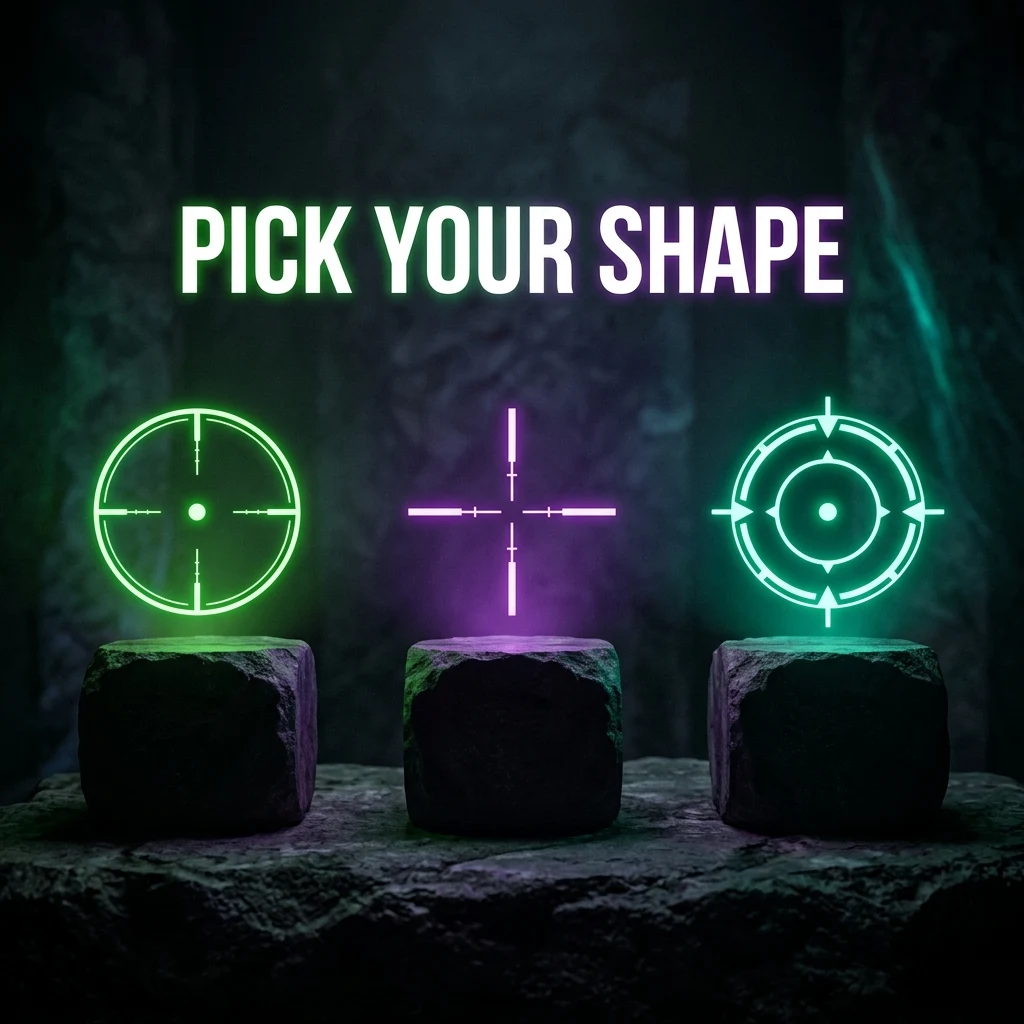
Dot. A single, minimal point at the center of your screen. Its biggest advantage is that it obscures almost nothing of the target underneath it, which matters most in games where headshot precision is rewarded heavily — you're aiming at the actual pixel, not guessing based on where a larger shape's center roughly sits. The tradeoff is that a dot gives you no peripheral reference for tracking movement or compensating for recoil climb; it's a single point with no surrounding structure to help your eyes anticipate where the reticle needs to go next.
Cross. Four short lines with a gap in the center, the classic reticle shape most FPS players think of by default. The lines give you a frame of reference beyond the exact center point, which helps with recoil control in particular — as your reticle climbs during a spray, the cross's arms give you a visual sense of how far and in what direction it's drifting, something a bare dot doesn't communicate as clearly. The tradeoff is that the lines themselves add a small amount of visual clutter directly around your point of aim, which some players find distracting during very precise, low-recoil engagements.
Circle. A ring, usually centered on a dot, that in most games represents the weapon's current accuracy cone rather than a fixed point — the circle expands when you move, jump, or fire, and shots land somewhere inside that expanded radius rather than exactly at the center. This makes a circle genuinely informative in games with meaningful hip-fire or movement-based spread, since it's communicating real information about where your next shot is statistically likely to land. In games with fixed, non-expanding accuracy (most tactical shooters), a circle has nothing extra to communicate and is rarely offered as a default option for that reason.
Which Shape Suits Which Playstyle
Players who lean on flicking and precise headshot placement — the exact demand in low-recoil, high-lethality games — tend to gravitate toward a dot or a very small cross with a large center gap, since minimizing target obstruction matters more than recoil reference in a game where most engagements are decided in one or two shots. Players in spray-heavy, sustained-fire games benefit more from a cross with visible arms, since the extra reference points genuinely help track a climbing spray pattern in real time rather than guessing at compensation blind.
There's no universally "best" shape independent of what you're actually doing in a given fight — a dot that's perfect for a one-tap headshot duel becomes a worse choice the moment you're spraying through a wall or tracking a strafing target, and a cross that helps with recoil tracking adds unnecessary clutter during a clean, precise flick. Many competitive players land on a small cross with a fairly wide gap specifically because it's a reasonable compromise between the two use cases, rather than being purpose-optimized for either one.
How This Changes by Game Genre
In tactical shooters with fixed, predictable spray patterns (CS2, Valorant), the community has overwhelmingly converged on small dots and small crosses with minimal or no dynamic movement, since recoil in these games follows a learnable, memorizable pattern rather than random bloom — a static reticle gives you a consistent reference to memorize spray control against, without the reticle itself changing shape and adding noise to that memorization.
In battle royales and looter-shooters with genuine hip-fire spread and movement-based accuracy penalties (Fortnite, Apex Legends, PUBG), circle-style reticles that visibly expand and contract are far more common and genuinely useful, since they're communicating real, changing information about shot dispersion rather than a fixed point that would be misleading during movement.
In hero shooters mixing hitscan and projectile weapons (Overwatch 2, Marvel Rivals), the choice often comes down to the specific hero being played rather than the genre as a whole — see our Marvel Rivals crosshair settings guide for exactly how that hitscan-vs-projectile distinction plays out hero by hero.
Static vs. Dynamic Crosshairs
A dynamic crosshair changes size or shape in real time based on movement, firing, or weapon spread — expanding when you sprint or shoot, contracting when you're still and aiming carefully. A static crosshair stays visually fixed regardless of what you're doing, even if the game's actual underlying accuracy is changing behind the scenes. The overwhelming majority of high-level competitive players in recoil-pattern-based games (CS2 and Valorant specifically) disable dynamic crosshair behavior entirely and play with a fully static reticle, because a fixed visual reference point is easier to build consistent muscle memory around than one that's constantly resizing based on your own movement — even if the dynamic version is, in theory, giving you more real-time information about your actual accuracy in that instant.
This preference doesn't necessarily carry over to games built around genuine, meaningful hip-fire spread as a core mechanic, where a dynamic reticle is directly telling you something true and useful (how wide your shots are likely to land right now) rather than just adding visual noise to a pattern you've already memorized.
Whichever shape and behavior you settle on, build and preview it with a live rendering before committing in-game using the DCPROSENS crosshair generator, and pair it with the right color for your maps using our crosshair color guide.
Gap and Length: The Overlooked Parameters
Shape gets most of the discussion, but two sub-parameters change how any of the three base shapes actually feel in practice. Gap — the distance between the center point and where the cross's arms begin — controls how much clear space sits directly around your point of aim. A larger gap keeps the arms further from the exact center, reducing target obstruction even on a cross shape, which is part of why many competitive cross-crosshair setups use a wide gap rather than a tight one; it borrows some of a dot's precision advantage without fully giving up the cross's recoil-reference lines. Length — how long each arm extends — changes how much peripheral reference the shape provides: longer arms give a stronger visual anchor for tracking recoil climb or a strafing target, at the cost of slightly more visual clutter near your point of aim.
In practice, a lot of what looks like a "dot vs. cross" preference is really a gap-and-length preference in disguise — a cross with a very wide gap and very short arms starts to behave and feel a lot like a dot with faint corner markers, rather than a fundamentally different shape. Worth experimenting with both dimensions in the crosshair generator before assuming you need to switch base shapes entirely to solve a specific visibility or tracking complaint.
What Changes When You Switch Games
A shape and gap combination tuned for one game's recoil pattern and pace doesn't automatically transfer cleanly to a different game, even beyond the crosshair-code incompatibility covered in our companion guide on importing and exporting crosshair codes. Moving from a spray-heavy game to a game with lighter, more one-shot-focused engagements is a reasonable moment to re-evaluate whether your cross's extra reference lines are still earning their visual cost, or whether a smaller dot would now serve you better given the new game's actual pace and lethality. Re-check your sensitivity at the same time using the sensitivity converter — a new crosshair shape and an unconverted sensitivity landing on the same day makes it hard to tell which change is responsible if your aim feels off afterward.
Frequently Asked Questions
Frequently Asked Questions
Is a dot crosshair better than a cross?
Neither is universally better — a dot obscures less of the target and suits precise, one-shot engagements, while a cross's extra reference lines help with tracking recoil and movement during sustained fire. The right choice depends on whether your game rewards precision flicking or spray control more heavily.
Do pro players prefer static or dynamic crosshairs?
In recoil-pattern-based tactical shooters like CS2 and Valorant, the large majority of professional players use a fully static crosshair, since a fixed visual reference is easier to build consistent muscle memory around than one that resizes based on movement or firing.
🎯 Lock In Perfect 1:1 Aim & Pro Consistency
Tired of daily aim inconsistency? Calibrate your physical cm/360, scope matching, and sensor latency. Get the complete Precision Aim System (4-Part Technical Manifestos) today for only $9.00 USD!
Unlock Elite Precision ($9) ⚡Dalto Outlier
Creator, DCPROSENSDalto built DCPROSENS to help competitive FPS players convert sensitivity, calibrate DPI, and keep their aim consistent across games.