Deadlock Ranks Explained — Full Tier List
TL;DR
Deadlock's ranked system, live since Beta Season 1 launched on July 30, 2026, has 11 tiers from Initiate to Eternus, each split into six subranks (I–VI) for 66 total badge levels. Rank is driven by a hidden MMR system that tracks both your overall skill and hero-specific skill separately, with in-match performance (net worth, objectives, KDA) feeding into that hidden number even though your visible badge only updates periodically.
Full Rank Tier List (Bottom to Top)
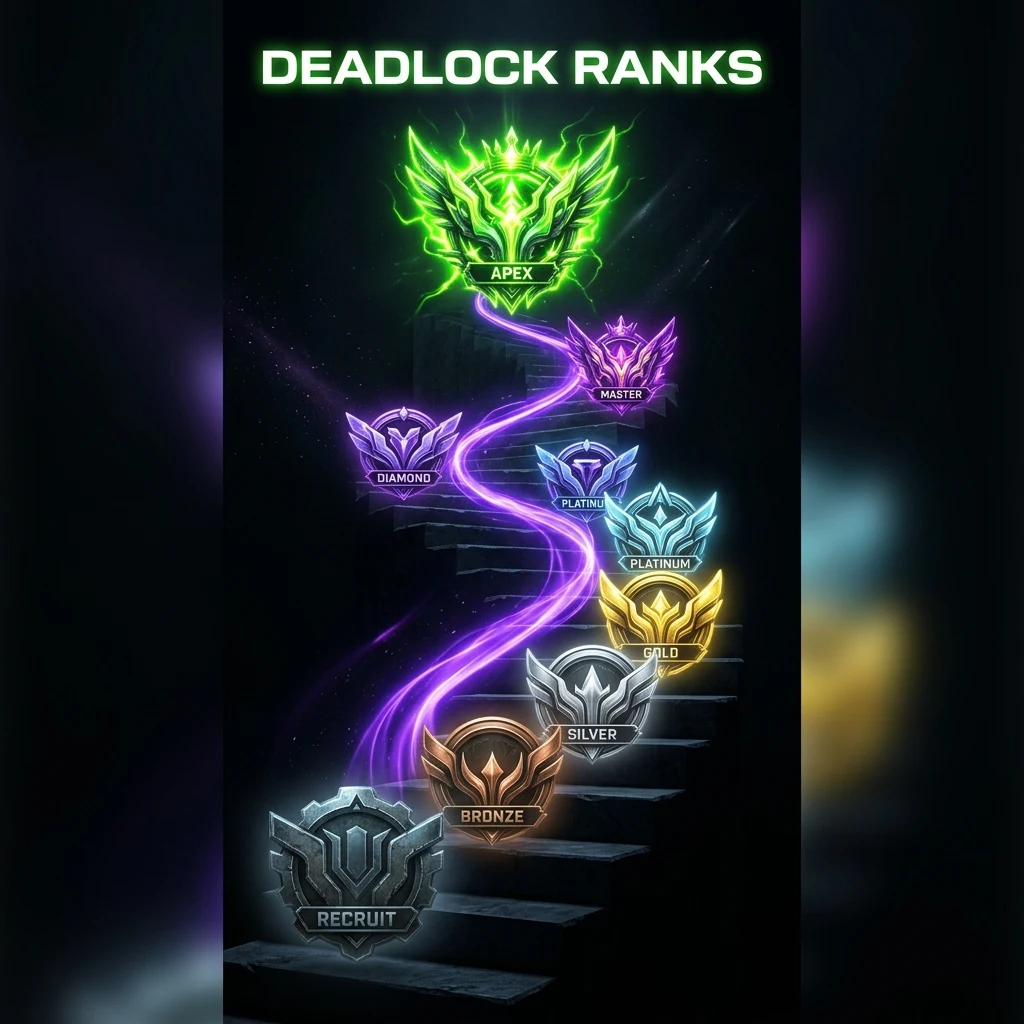
Deadlock's 11 ranked tiers, in ascending order, are: Initiate, Seeker, Alchemist, Arcanist, Ritualist, Emissary, Archon, Oracle, Phantom, Ascendant, and Eternus at the top. Below Initiate sits Obscurus, a placement state rather than a true rank — new ranked players start here and are placed into their first real rank after enough matches for the system to get an initial read on their skill.
Each of the 11 named tiers is further split into six subranks, numbered I through VI, giving 66 total ranked badge levels. Your exact badge is calculated as (tier × 10) + subrank, which is how the game encodes a precise position within the ladder rather than just a coarse tier name.
| Tier (low to high) | Subranks |
|---|---|
| Obscurus | Placement state, not a scored rank |
| Initiate | I–VI |
| Seeker | I–VI |
| Alchemist | I–VI |
| Arcanist | I–VI |
| Ritualist | I–VI |
| Emissary | I–VI |
| Archon | I–VI |
| Oracle | I–VI |
| Phantom | I–VI |
| Ascendant | I–VI |
| Eternus | I–VI (highest overall) |
According to rank-distribution tracking, the top 30% of the ranked population sits above Emissary 4, the top 20% starts around Archon 2, the top 10% falls between Oracle 3 and Oracle 4, and Phantom holds roughly the top 7–4% of players — with Oracle being the single most populated tier overall. Eternus, at the very top, represents the smallest and most elite slice of the playerbase.
Because ranked launched with Beta Season 1 rather than a fully mature, long-running ladder, expect the exact distribution and cutoffs above to shift as Valve gathers more data and tunes the MMR curve — a pattern common to any newly launched competitive mode, where the first few months see faster average rank movement and looser calibration than a system that's been live for years. Treat the percentile breakdown as a snapshot of the current beta state rather than a permanently fixed target.
How MMR/Rank Works
Deadlock's ranked system runs on MMR (matchmaking rating) — a hidden numeric skill estimate that determines your matchmaking pool — separate from your visible badge, which is a periodically-updated public representation of that hidden number. Deadlock tracks two layers of MMR simultaneously: a core MMR representing your overall skill, and a hero-specific MMR for each individual hero you play, with matchmaking taking both into account. This means your matches aren't just balanced around your general skill — the system also factors in whether you're playing a hero you're historically strong or weak on.
What moves your hidden MMR isn't purely win or loss. In-match performance — net worth accumulation, objective participation, and KDA — feeds into the hidden MMR calculation alongside the match result itself, meaning a strong individual performance in a loss can still move your MMR upward even though your visible badge is tied more directly to overall win/loss outcomes over time. Your badge updates in real time as new matches are processed, rather than requiring a full season's worth of games to shift.
Why Obscurus Exists Before Your First Real Rank
Obscurus isn't a rank you can be demoted back into — it's a one-time placement window every new ranked player passes through before the system has enough performance data to assign a meaningful starting badge. Seeding a brand-new account directly into a named tier with zero match history would force the matchmaker to guess blind, producing lopsided early games in both directions (an experienced player crushing unranked lobbies, or a genuine beginner getting steamrolled in a tier that assumed more skill than they had). Obscurus exists specifically to collect that initial signal — net worth trends, objective participation, and match outcomes across your first ranked games — before locking in where you land on the 66-level ladder.
Because that placement badge is a starting estimate rather than a fixed judgment, a rough Obscurus stretch (a few bad games while you're still adjusting to ranked's stakes) doesn't permanently cap where you can end up — hidden MMR keeps updating with every game afterward regardless of how the initial placement landed.
How to Rank Up Faster
Since hero-specific MMR is tracked separately from your core rating, concentrating your ranked games on a smaller pool of heroes you actually know well tends to produce more consistent rank movement than constantly switching to unfamiliar picks — your hero MMR on a new hero starts closer to your core MMR rather than reflecting your accumulated mastery on your mains, so playing a fresh hero in ranked is effectively playing at a temporary skill disadvantage relative to your usual level.
Because in-match performance factors into your hidden MMR independently of the final result, focusing on the specific things that objectively drive net worth and objective control — last-hitting consistently, prioritizing objectives over purely personal kills, and staying alive to keep contributing — tends to move your hidden rating more reliably than chasing kills alone, since kills are only one input among several the system is actually weighing.
Consistency matters as much as raw skill here: because badge updates happen after a set number of processed games rather than instantly reflecting every single match, a long losing streak from tilt or fatigue can drag your badge down meaningfully before it has a chance to recover — stepping away after a bad string of losses protects your hidden MMR from compounding mistakes as much as it protects your mental state.
If you're switching into Deadlock from another shooter and want your aim to transfer cleanly to ranked matches, get your sensitivity converted correctly first with the Deadlock sensitivity converter — Deadlock runs on the Source 2 engine, so if you're coming from CS2 specifically, your sensitivity carries over 1:1 without any conversion needed. Warming up your tracking and flick accuracy before a ranked session with the free DCPROSENS Aim Trainer is also worth doing, since Deadlock leans more on sustained tracking than pure flicking compared to a traditional tactical shooter.
For how a comparable rank system works in a different genre, see our companion guide on Overwatch 2's ranking system — the tier-and-division structure will feel familiar even though the underlying hero-specific MMR layer is unique to Deadlock.
Why Deadlock's Two-Layer MMR Is Different From Most Hero Shooters
Most competitive hero-based games — Overwatch 2 included — track skill per role rather than per individual hero, on the logic that Tank, Damage, and Support each demand different enough skills to warrant separate ratings, but that any hero within a role is roughly interchangeable for matchmaking purposes. Deadlock's decision to track MMR at the individual hero level is a meaningfully finer-grained approach: it assumes a player's mastery of one specific hero doesn't reliably predict their performance on a different one, even within a similar in-game archetype. Practically, this means your matchmaking experience can vary noticeably hero to hero in a way that role-based systems don't fully capture — you might be facing appropriately-matched opponents on your main hero while getting outmatched on a hero you rarely touch, purely because that hero's individual MMR hasn't caught up to your general skill level yet.
This also explains why "one-trick" strategies (deeply specializing in a small handful of heroes rather than playing a wide roster) tend to produce faster, more stable rank climbing in Deadlock specifically — your hero MMR for your mains accumulates real signal over many games, while a wide roster spreads that signal thin across many separately-tracked, less-calibrated numbers.
How Deadlock's Ranks Compare to Other Games You Might Already Know
If you're coming from a MOBA background, the tier-and-subrank structure (11 named tiers, six subranks each) will feel closer to a traditional MOBA medal system than to a tactical shooter's flatter skill-group list — CS2's 18 Competitive ranks or Valorant's rank ladder, for comparison, don't subdivide each named tier into six numbered steps the way Deadlock does. That extra granularity means climbing within a single named tier (say, moving from Archon I to Archon VI) represents real, measurable progress even before you cross into the next named rank, which can make Deadlock's ladder feel slower to "name-change" but more continuously rewarding step to step.
If you're coming from a hero shooter like Overwatch 2 instead, the biggest adjustment is the hero-specific MMR layer covered above — Overwatch 2 tracks skill per role, not per individual hero, so a Deadlock player switching heroes for the first time inside ranked should expect a bigger temporary skill-matching gap than an Overwatch 2 player switching heroes within their main role would.
Frequently Asked Questions
Frequently Asked Questions
What is the highest rank in Deadlock?
Eternus is the highest of Deadlock's 11 ranked tiers, sitting above Ascendant, Phantom, Oracle, Archon, Emissary, Ritualist, Arcanist, Alchemist, Seeker, and Initiate. Like every other tier, it's further split into six subranks (Eternus I through Eternus VI).
How does Deadlock's ranked matchmaking work?
Deadlock uses a hidden MMR system that tracks both your overall core skill and your skill on each individual hero separately, with matchmaking accounting for both. In-match performance — net worth, objectives, and KDA — feeds into your hidden MMR alongside the match result, and your visible badge updates periodically to reflect that underlying rating.
🎯 Lock In Perfect 1:1 Aim & Pro Consistency
Tired of daily aim inconsistency? Calibrate your physical cm/360, scope matching, and sensor latency. Get the complete Precision Aim System (4-Part Technical Manifestos) today for only $9.00 USD!
Unlock Elite Precision ($9) ⚡Dalto Outlier
Creator, DCPROSENSDalto built DCPROSENS to help competitive FPS players convert sensitivity, calibrate DPI, and keep their aim consistent across games.