CS2 Ranks & Rating System Explained
TL;DR
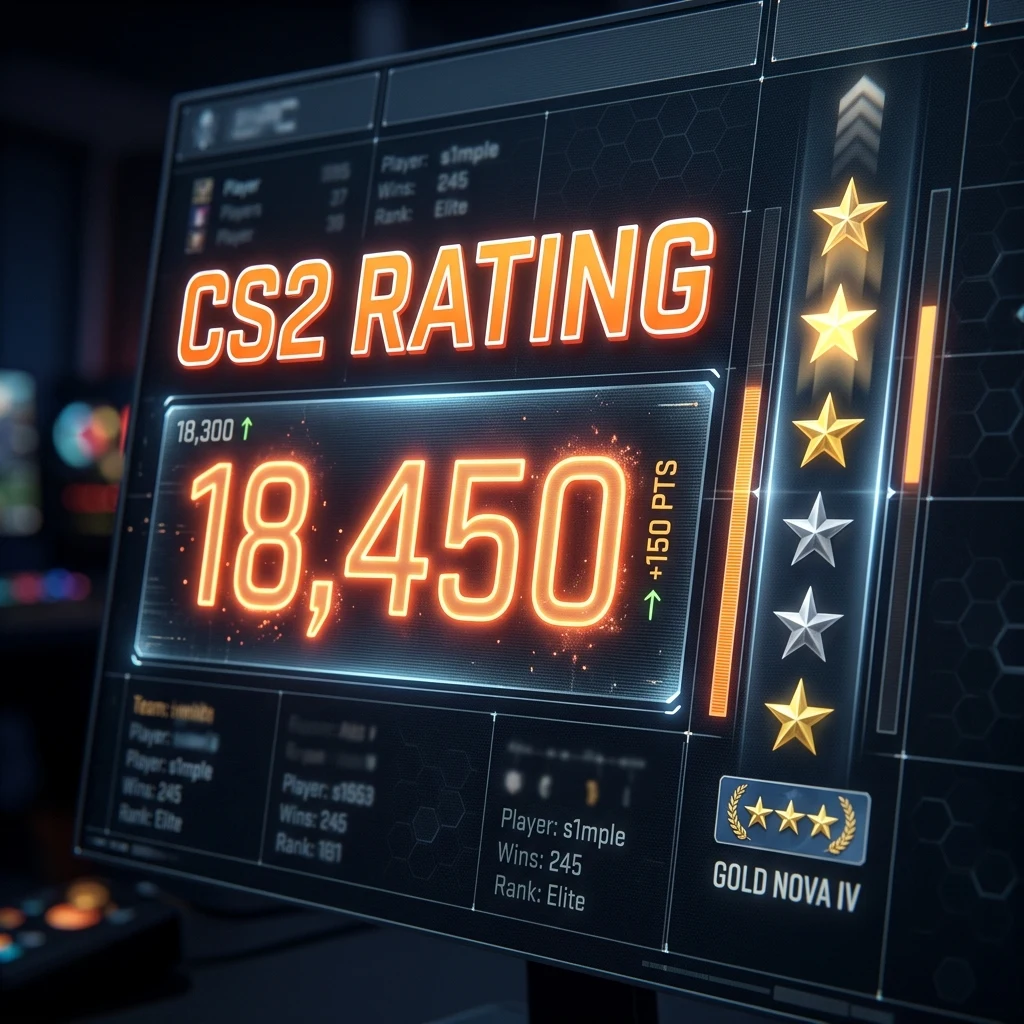
CS2 tracks two entirely separate ranking systems that don't affect each other: Competitive mode's 18 skill groups (Silver I through Global Elite, now earned per-map rather than account-wide), and Premier mode's numeric CS Rating, which runs from 0 to over 35,000 and maps to seven color tiers from Grey to Gold. A Premier rating above 15,000 is above average, and fewer than 2% of players reach 20,000 or higher.
Premier Rating Explained
Premier mode represents your skill as a single numeric CS Rating, ranging from 0 up to 35,000 and beyond at the very top of the distribution. It functions similarly to an Elo-style rating (comparable in spirit to FACEIT's rating system): your number moves up after a win and down after a loss, with the size of that swing scaled by round differential and the strength of the opponents you played against, rather than a fixed amount per win.
That numeric rating maps onto seven color-coded tiers:
| CS Rating range | Color tier |
|---|---|
| 0 – 4,999 | Grey |
| 5,000 – 9,999 | Light Blue |
| 10,000 – 14,999 | Blue |
| 15,000 – 19,999 | Purple |
| 20,000 – 24,999 | Pink |
| 25,000 – 29,999 | Red |
| 30,000+ | Gold |
As of mid-2026, Blue (10,000–14,999) is the most populated Premier tier, with Light Blue (5,000–9,999) close behind — meaning most active Premier players sit in the lower-middle of the full rating range rather than clustering near the top. Premier also layers in nine separate leaderboards — Friends, World, and regional boards for Africa, Asia, Europe, China, North America, South America, and Australia — so you can compare your CS Rating against friends specifically or against players in your own region, not just a single global number.
Old Rank System vs. Premier
Competitive mode (the direct successor to CS:GO's classic ranking) uses 18 skill groups, from lowest to highest: Silver I, Silver II, Silver III, Silver IV, Silver Elite, Silver Elite Master, Gold Nova I, Gold Nova II, Gold Nova III, Gold Nova Master, Master Guardian I, Master Guardian II, Master Guardian Elite, Distinguished Master Guardian, Legendary Eagle, Legendary Eagle Master, Supreme Master First Class, and Global Elite at the very top. Global Elite is held by roughly 0.75% of all players, making it one of the more exclusive top ranks in mainstream competitive gaming.
CS2 changed one significant thing from CS:GO here: skill groups are now tied to specific maps rather than applying as one global rank across your whole account. You unlock a rank on a given map only after winning two competitive matches on it, meaning a player can genuinely be Global Elite on Mirage while still unranked or lower-ranked on a map they rarely queue into.
Crucially, Competitive skill groups and Premier CS Rating are tracked completely independently — your performance in one mode has no direct effect on your rank or rating in the other. A player can be Global Elite in Competitive while sitting mid-Blue in Premier, or the reverse, since the two systems accumulate separate histories from separate match pools.
Why Per-Map Competitive Ranks Changed How Players Practice
Requiring two wins on a specific map before you're even assigned a rank there was a meaningful shift from CS:GO's single global rank, and it changed practical behavior for a lot of players. Under the old system, a player could coast on a strong overall rank while genuinely struggling on one or two specific maps they rarely played, since the single combined number smoothed that weakness out. Per-map ranks remove that smoothing — a Global Elite player who's never queued Nuke doesn't get to claim Global Elite performance there until they've actually proven it on that specific map, which incentivizes practicing a fuller map pool rather than avoiding weak maps indefinitely while your account rank quietly papers over the gap.
How Rating Is Calculated Per Match
In Premier mode, your CS Rating adjustment after each match is driven by two main inputs: round differential (how decisively you won or lost, not just the binary result) and the strength of the opponent team you played, similar in principle to how chess Elo weighs beating a stronger opponent more heavily than beating a weaker one. A close loss against a much higher-rated team can cost you relatively little rating, while a lopsided loss against a similarly-rated team costs more — the system is reading the full scoreline, not just win or lose.
In Competitive mode, rank movement isn't published as a fully transparent formula the way Premier's rating swings are, but it follows the same general logic common to skill-group systems: consistent wins move you up, consistent losses move you down, and because it's per-map, your progress on any individual map depends on your win rate specifically on that map rather than your overall account performance.
If you're building or adjusting your setup around a specific rating goal, dial in your sensitivity first with the CS2 sensitivity converter and lock in a crosshair with the DCPROSENS crosshair generator — neither directly raises your CS Rating, but a mismatched sensitivity or a crosshair that disappears on your active-duty maps costs you rounds you'd otherwise win cleanly. For how a comparable rating system stacks up in a different tactical shooter, see our companion guide on Rainbow Six Siege's ranks and MMR.
Why Valve Runs Two Separate Systems Instead of One
Competitive and Premier serve genuinely different purposes rather than being a redundant duplicate of each other. Competitive's per-map skill groups reward focused practice on a small map pool and give a simple, familiar tier label most players recognize from CS:GO. Premier's single numeric rating, by contrast, is built around its map-veto/ban-and-pick match structure and its regional leaderboard system, giving a more granular, continuously-updating number well suited to precise skill comparison and competitive ladder-climbing across a rotating map pool rather than a fixed one. Running both in parallel lets Valve serve the "I want a simple rank label" audience and the "I want a precise, comparable number" audience without forcing either into a compromise format.
Because the two systems don't share data, a rank or rating earned in one carries no guaranteed relationship to the other — don't assume a Premier rating automatically implies a matching Competitive skill group, and vice versa, when sizing up an unfamiliar player or teammate.
What This Means for Choosing Which Mode to Grind
If your goal is a simple, widely-recognized status symbol, Competitive's named skill groups (particularly Global Elite, held by roughly 0.75% of players) carry more instant recognition within the community than a specific CS Rating number does — most players know exactly what "Global Elite" means without needing extra context, whereas a Premier rating like "18,400" requires knowing the color-tier breakdown to interpret at a glance. If your goal is precise, ongoing comparison against friends or regional competition, Premier's numeric rating and nine dedicated leaderboards give a far more granular picture than an 18-step skill-group ladder can. Many competitive players end up grinding both anyway, since Competitive's per-map focus is genuinely useful practice for mastering the specific Active Duty map pool that Premier itself draws from.
How This Compares to Games With a Single Rating System
Not every competitive shooter splits skill representation this way — Rainbow Six Siege and Overwatch 2, covered in our companion guides on R6 Siege's ranks and Overwatch 2's ranking system, each run a single primary competitive mode with one core rating model (even where Overwatch 2 splits that rating by role, it's still one unified underlying system rather than two independently-tracked modes). CS2's dual-system approach is closer to a deliberate design choice than an industry standard, reflecting Valve's specific decision to preserve the CS:GO-era Competitive experience players already knew while building Premier as a separate, more modern ladder alongside it rather than replacing the old system outright.
What a Rank or Rating Doesn't Tell You
Neither system captures everything relevant to how tough an opponent actually is in a given match. Competitive's per-map skill groups say nothing about a player's form on maps outside their unlocked pool, and Premier's CS Rating, while more continuously updated, can still lag behind a player's current actual skill during a hot or cold streak, since rating changes accumulate gradually rather than jumping instantly to reflect a sudden improvement or decline. Both are useful, evidence-based estimates of skill — not a perfect, real-time readout of exactly how a specific opponent will play in the next round. Treat either number as a strong prior, not a guarantee, when sizing up a lobby.
This also matters when interpreting your own rank or rating after a rough stretch. A dip in Premier CS Rating following a handful of bad matches doesn't necessarily mean your underlying skill dropped — it can just as easily reflect a short losing streak the rating hasn't fully recovered from yet, the same lag effect working in the opposite direction. Judging your actual current form from a small handful of recent matches, rather than the rating itself, is generally the more accurate read in either direction.
Frequently Asked Questions
Frequently Asked Questions
What's a good CS2 Premier rating?
A CS Rating of 15,000 or above (the Purple tier) is generally considered above average. Fewer than 2% of players ever reach 20,000 or higher, so anything in the Pink tier and up represents a genuinely small, high-skill slice of the Premier population.
How many wins to rank up in CS2?
It depends which system: in Competitive, you need two wins on a specific map to unlock your first rank there, then further wins and losses move you up or down over time on a per-map basis. In Premier, there's no fixed win count — your CS Rating adjusts every single match based on round differential and opponent strength, win or lose.
🎯 Lock In Perfect 1:1 Aim & Pro Consistency
Tired of daily aim inconsistency? Calibrate your physical cm/360, scope matching, and sensor latency. Get the complete Precision Aim System (4-Part Technical Manifestos) today for only $9.00 USD!
Unlock Elite Precision ($9) ⚡Dalto Outlier
Creator, DCPROSENSDalto built DCPROSENS to help competitive FPS players convert sensitivity, calibrate DPI, and keep their aim consistent across games.